
Sunday, July 31, 2005


Thursday, July 28, 2005
FUD
The Register writes:
IE7 integrates search into the browser, but the only option is Microsoft's own MSN Search.
Really? Here's what my version looks like:
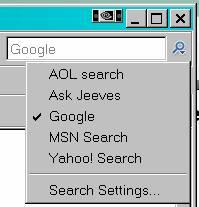
And guess what? My default search engine in IE6 was Google, and it bound the IE7 search box to it by default after upgrading. Way to respect, IE team!
About a month ago I had an interesting exchange via blog comments with a buddy of mine who works for Apple. The conversation eventually moved over to AIM... and he asked if I'd wager $50 against his claim that IE7 wouldn't easily let users change their default search engine. Having no insider information whatsoever (my pre-beta version at the time didn't have this feature yet), I agreed -- despite the fact that Apple's own browser, Safari, does not provide the same functionality.
Mike, how about donating the $50 to the Mozilla Foundation? It's no secret that their healthy competition helped bring about IE7 -- I don't mind helping them continue to push the limits.
It's also worth noting that while I can't talk about what's coming in Beta 2, Beta 1 isn't meant to be a showcase of flashy innovations for the end user.D on't believe the FUD in the meantime.
Scoble has more on this...
Update: The Register updated their story, but still don't cut Microsoft any slack.
IE7 integrates search into the browser, but the only option is Microsoft's own MSN Search.
Really? Here's what my version looks like:
And guess what? My default search engine in IE6 was Google, and it bound the IE7 search box to it by default after upgrading. Way to respect, IE team!
About a month ago I had an interesting exchange via blog comments with a buddy of mine who works for Apple. The conversation eventually moved over to AIM... and he asked if I'd wager $50 against his claim that IE7 wouldn't easily let users change their default search engine. Having no insider information whatsoever (my pre-beta version at the time didn't have this feature yet), I agreed -- despite the fact that Apple's own browser, Safari, does not provide the same functionality.
Mike, how about donating the $50 to the Mozilla Foundation? It's no secret that their healthy competition helped bring about IE7 -- I don't mind helping them continue to push the limits.
It's also worth noting that while I can't talk about what's coming in Beta 2, Beta 1 isn't meant to be a showcase of flashy innovations for the end user.D on't believe the FUD in the meantime.
Scoble has more on this...
Update: The Register updated their story, but still don't cut Microsoft any slack.
Thursday, July 21, 2005
Passionate customers make for passionate engineers
This morning I got an email forward from Jim Allchin. Apparently, an eager Microsoft customer FedEx'd two pounds of inscribed chocolate to one of our test managers, Paul Donnelly:

How cool is that?
In case you're wondering, the guy's invitation to test Longhorn Beta 1 was sent out yesterday, and the chocolate is being made available in the Longhorn shiproom for everyone to enjoy today.
Update: To be clear, Hershey's makes the tasty chocolate, but is not the customer. </disclaimer>

How cool is that?
In case you're wondering, the guy's invitation to test Longhorn Beta 1 was sent out yesterday, and the chocolate is being made available in the Longhorn shiproom for everyone to enjoy today.
Update: To be clear, Hershey's makes the tasty chocolate, but is not the customer. </disclaimer>
Wednesday, July 20, 2005
Quick updates...
In the event that you were wondering about the moblog pictures of me in a tux, they're from another good friend's wedding in LA over the weekend. Look at my geeky dad and my sister's boyfriend taking pictures with their cell phones!
Unbelievable. A few years ago, my mother wouldn't touch the computer. Now she's asking me how to send photos to her friends and change the background on her phone to a picture of her puppy.
On the flight down to LA, I finally had the chance to finish Malcolm Gladwell's latest book, Blink: The Power of Thinking Without Thinking. I like Gladwell quite a bit, and Blink was an incredibly quick and engaging read. I'll spare you the review, since there are undoubtedly thousands already online, but in short, it was a little less thought provoking and original than The Tipping Point, but still quite interesting (maybe even more interesting) and I'd highly recommend checking it out.
Anyhow, Blink was the only book I brought down to LA for the weekend. Finishing it on the flight down left me bookless, so I borrowed and started reading my dad's copy of Good to Great, which I'm quite pleased with so far. I've been getting so many great book recommendations lately.. I've got 9 waiting on my nightstand here at home (so please don't send me any books!), and 21 more on my Amazon.com wish list. What are you reading?
I found another podcast that I like - diggnation. It's by Kevin Rose and Alex Albrecht, who basically follow the biggest stories from digg.com. I've found that listening to podcasts really does make the morning commute out to Redmond bearable.
Finally, I recently saw Broken Wings and Born Into Brothels. The first is an incredibly moving Israeli family drama that won quite a few international film awards. The latter, which I just watched tonight, won the 2005 Academy Award for best documentary (among other awards). Born Into Brothels was incredibly depressing, and serves as yet another affirmation of the feeling I get sometimes that many of us live in a bubble, detached from reality of what's going on elsewhere in the world.
With that, I bid you goodnight.
Unbelievable. A few years ago, my mother wouldn't touch the computer. Now she's asking me how to send photos to her friends and change the background on her phone to a picture of her puppy.
On the flight down to LA, I finally had the chance to finish Malcolm Gladwell's latest book, Blink: The Power of Thinking Without Thinking. I like Gladwell quite a bit, and Blink was an incredibly quick and engaging read. I'll spare you the review, since there are undoubtedly thousands already online, but in short, it was a little less thought provoking and original than The Tipping Point, but still quite interesting (maybe even more interesting) and I'd highly recommend checking it out.
Anyhow, Blink was the only book I brought down to LA for the weekend. Finishing it on the flight down left me bookless, so I borrowed and started reading my dad's copy of Good to Great, which I'm quite pleased with so far. I've been getting so many great book recommendations lately.. I've got 9 waiting on my nightstand here at home (so please don't send me any books!), and 21 more on my Amazon.com wish list. What are you reading?
I found another podcast that I like - diggnation. It's by Kevin Rose and Alex Albrecht, who basically follow the biggest stories from digg.com. I've found that listening to podcasts really does make the morning commute out to Redmond bearable.
Finally, I recently saw Broken Wings and Born Into Brothels. The first is an incredibly moving Israeli family drama that won quite a few international film awards. The latter, which I just watched tonight, won the 2005 Academy Award for best documentary (among other awards). Born Into Brothels was incredibly depressing, and serves as yet another affirmation of the feeling I get sometimes that many of us live in a bubble, detached from reality of what's going on elsewhere in the world.
With that, I bid you goodnight.
Sunday, July 17, 2005
How Customer Focused Design Can Stifle Innovation
There's something happening right now that truly amazes me: podcast support in iTunes.
It's not an amazing feature, or a mindblowing leap in technology. And that's why I find what's happening amazing.
What the heck am I talking about?
It all started a couple of weeks ago, when Apple announced podcast support in iTunes 4.9. Since the week it was released, I've noticed that in many of the podcasts I listen to, the podcasters are beginning to constantly beg their listeners to switch to iTunes for downloading and listening to their podcasts.
Why do they want their users to switch to iTunes?
iTunes maintains a "Top 100" list of podcasts. Every podcaster wants his/her podcast to top the iTunes chart, which in turn means more eyeballs on the chart, which in turn means more incentive for the podcasters to want to top the chart, which in turn means more eyeballs on the chart, which in turn means ... you get the point.
So here, with this simple feature that in no way pushes the limits of technology, Apple has positioned itself as the number one source of podcasting content (and fueled use of the iTunes software and music store, and of course, fueled iPod sales, and maybe even fueled Apple's general "cool factor" thereby fueling other hardware sales).
Now, I'm going to take a step back, and talk a bit about the big picture. Last week, I spent two hours every morning in Customer Focused Design (CFD) meetings for a new software product. The CFD process was centered around the tried and true Kano Methodology (here's a more brief overview). In short, the Kano methodology is a way of understanding which product attributes are important to customers by discovering how the extent of their presence might impact customer satisfaction and customer dissatisfaction.
Attributes are then classified into four groups: "must haves", "one-dimensionals", "attractives", and "indifferents". In the end, attributes, and specific requirements to attain the attributes, are prioritized according to their classifications. So for example, "must haves" (i.e. "the car must have a stereo") and one-dimensionals (i.e. "the car must get good gas mileage") are generally prioritized above attractives (i.e. "the car stereo must have an iPod connector").
Here's where the process begins to break down. We sometimes become so focused on listening to what the customer wants, that we lose sight of the fact that the customer often doesn't know what the customer wants (or alternatively, what the customer wants is not good for our company or our product).
This is exactly what Clayton Christensen talks about in The Innovator's Dilemma. Business Week has a copy of what I'd argue is the most significant chapter online here.
Why were the leading drive makers unable to launch 8-inch drives until it was too late? Clearly, they were technologically capable of producing these drives. Their failure resulted from delay in making the strategic commitment to enter the emerging market in which the 8-inch drives initially could be sold. Interviews with marketing and engineering executives close to these companies suggest that the established 14-inch drive manufacturers were held captive by customers. Mainframe computer manufacturers did not need an 8-inch drive. In fact, they explicitly did not want it: they wanted drives with increased capacity at a lower cost per megabyte. The 14-inch drive manufacturers were listening and responding to their established customers. And their customers--in a way that was not apparent to either the disk drive manufacturers or their computer-making customers--were pulling them along a trajectory of 22 percent capacity growth in a 14-inch platform that would ultimately prove fatal. (Bolding added for emphasis)
So, here's a question for you. If a company spends all its efforts responding to the needs of its customers, to what extent can it truly innovate?
It can provide some technologically innovative solutions to meet needs expressed in customer feedback. But what about the needs that aren't expressed because they aren't known? Can a company create new markets this way?
Anyhow, I'll take this full circle back to the iTunes podcasting support. Let's see.. the first version of iTunes with podcasting support was released a few weeks ago. How long does it take a software feature to go from planning/design to implementation to release? 3 months? 6 months? 12 months? I think it's safe to assume that Apple made the decision to be the first to support podcasting quite some time ago - before there was a market - when customers might've rated podcast support as "attractive", or very possibly even "indifferent", but certainly not "must have" or "one-dimensional" (what % of iTunes users listened to podcasts 6-12 months ago, considering most of my friends still don't know what a podcast is?)
Apple saw past the needs of their customers and their market (potential customers). They set the bar, so that "podcast support" will now become a "must have" for their competitors.
They used a simple concept, a Top 100 list, to secure their position and get both podcasters and podcast listeners to almost instantly switch to their brand new service.
And that, I think, is amazing.
It's not an amazing feature, or a mindblowing leap in technology. And that's why I find what's happening amazing.
What the heck am I talking about?
It all started a couple of weeks ago, when Apple announced podcast support in iTunes 4.9. Since the week it was released, I've noticed that in many of the podcasts I listen to, the podcasters are beginning to constantly beg their listeners to switch to iTunes for downloading and listening to their podcasts.
Why do they want their users to switch to iTunes?
iTunes maintains a "Top 100" list of podcasts. Every podcaster wants his/her podcast to top the iTunes chart, which in turn means more eyeballs on the chart, which in turn means more incentive for the podcasters to want to top the chart, which in turn means more eyeballs on the chart, which in turn means ... you get the point.
So here, with this simple feature that in no way pushes the limits of technology, Apple has positioned itself as the number one source of podcasting content (and fueled use of the iTunes software and music store, and of course, fueled iPod sales, and maybe even fueled Apple's general "cool factor" thereby fueling other hardware sales).
Now, I'm going to take a step back, and talk a bit about the big picture. Last week, I spent two hours every morning in Customer Focused Design (CFD) meetings for a new software product. The CFD process was centered around the tried and true Kano Methodology (here's a more brief overview). In short, the Kano methodology is a way of understanding which product attributes are important to customers by discovering how the extent of their presence might impact customer satisfaction and customer dissatisfaction.
Attributes are then classified into four groups: "must haves", "one-dimensionals", "attractives", and "indifferents". In the end, attributes, and specific requirements to attain the attributes, are prioritized according to their classifications. So for example, "must haves" (i.e. "the car must have a stereo") and one-dimensionals (i.e. "the car must get good gas mileage") are generally prioritized above attractives (i.e. "the car stereo must have an iPod connector").
Here's where the process begins to break down. We sometimes become so focused on listening to what the customer wants, that we lose sight of the fact that the customer often doesn't know what the customer wants (or alternatively, what the customer wants is not good for our company or our product).
This is exactly what Clayton Christensen talks about in The Innovator's Dilemma. Business Week has a copy of what I'd argue is the most significant chapter online here.
Why were the leading drive makers unable to launch 8-inch drives until it was too late? Clearly, they were technologically capable of producing these drives. Their failure resulted from delay in making the strategic commitment to enter the emerging market in which the 8-inch drives initially could be sold. Interviews with marketing and engineering executives close to these companies suggest that the established 14-inch drive manufacturers were held captive by customers. Mainframe computer manufacturers did not need an 8-inch drive. In fact, they explicitly did not want it: they wanted drives with increased capacity at a lower cost per megabyte. The 14-inch drive manufacturers were listening and responding to their established customers. And their customers--in a way that was not apparent to either the disk drive manufacturers or their computer-making customers--were pulling them along a trajectory of 22 percent capacity growth in a 14-inch platform that would ultimately prove fatal. (Bolding added for emphasis)
So, here's a question for you. If a company spends all its efforts responding to the needs of its customers, to what extent can it truly innovate?
It can provide some technologically innovative solutions to meet needs expressed in customer feedback. But what about the needs that aren't expressed because they aren't known? Can a company create new markets this way?
Anyhow, I'll take this full circle back to the iTunes podcasting support. Let's see.. the first version of iTunes with podcasting support was released a few weeks ago. How long does it take a software feature to go from planning/design to implementation to release? 3 months? 6 months? 12 months? I think it's safe to assume that Apple made the decision to be the first to support podcasting quite some time ago - before there was a market - when customers might've rated podcast support as "attractive", or very possibly even "indifferent", but certainly not "must have" or "one-dimensional" (what % of iTunes users listened to podcasts 6-12 months ago, considering most of my friends still don't know what a podcast is?)
Apple saw past the needs of their customers and their market (potential customers). They set the bar, so that "podcast support" will now become a "must have" for their competitors.
They used a simple concept, a Top 100 list, to secure their position and get both podcasters and podcast listeners to almost instantly switch to their brand new service.
And that, I think, is amazing.
Monday, July 11, 2005
Innovation
I really like what Rory Blyth has to say about innovation and what makes a product great.
I'm so tired of hearing the word innovation misused and abused, and I'll be the first to stand up and admit I'm as guilty as any.
I'm especially tired of hearing criticism against companies for "not being innovative". There are undoubtedly many cases in which specific products have stagnated, especially in markets where competition is nonexistent. But to claim an entire company is not innovative - I generally don't buy it (either that, or you're right, and the company's about to be driven out of all of their markets and go byebye).
In any event, I'll leave you with Wikipedia's definition of innovation, in case you're curious after reading Rory's blog posts. I think it's summed up pretty well.
I'm so tired of hearing the word innovation misused and abused, and I'll be the first to stand up and admit I'm as guilty as any.
I'm especially tired of hearing criticism against companies for "not being innovative". There are undoubtedly many cases in which specific products have stagnated, especially in markets where competition is nonexistent. But to claim an entire company is not innovative - I generally don't buy it (either that, or you're right, and the company's about to be driven out of all of their markets and go byebye).
In any event, I'll leave you with Wikipedia's definition of innovation, in case you're curious after reading Rory's blog posts. I think it's summed up pretty well.
Saturday, July 09, 2005
10 informal minutes with my CEO
I realize I'm a few days late with this one... spent all day Thursday and Friday in Engineering Excellence training and just now sitting down on a beautiful Saturday afternoon to catch up on some real work.
So, Robert Scoble got a great 10 minutes of talk time with Steve Ballmer. I agree with Gretchen... it is funny to hear Robert nervous. ;-)
It's interesting to think about... I'd probably be pretty nervous interviewing Steve Ballmer too. Last month, when my friend Dan asked him a question at a more formal talk, he was obviously quite nervous too (but not nervous enough to deter him from asking, so props for that!).
So I'm wondering, does anyone have any advice on how to get over feeling nervous in such situations? I mean, the boss's boss is just another regular guy outside the office. And I don't think the nervousness correlates to fear of getting in trouble or losing ones job. So what is it? And what can we do to get over it??
BTW, Robert, is SteveB the first interviewee to deserve a tripod? ;-)
So, Robert Scoble got a great 10 minutes of talk time with Steve Ballmer. I agree with Gretchen... it is funny to hear Robert nervous. ;-)
It's interesting to think about... I'd probably be pretty nervous interviewing Steve Ballmer too. Last month, when my friend Dan asked him a question at a more formal talk, he was obviously quite nervous too (but not nervous enough to deter him from asking, so props for that!).
So I'm wondering, does anyone have any advice on how to get over feeling nervous in such situations? I mean, the boss's boss is just another regular guy outside the office. And I don't think the nervousness correlates to fear of getting in trouble or losing ones job. So what is it? And what can we do to get over it??
BTW, Robert, is SteveB the first interviewee to deserve a tripod? ;-)
Wednesday, July 06, 2005
On music, magazines, and marriage
 I hope everyone had a wonderful 4th of July weekend. I left work early Friday and flew down to Los Angeles to spend an amazing weekend with family and friends, and for a very special wedding of a close family friend.
It's funny, before my cousin's recent wedding, I don't think I had been to a wedding in about ten years. And now, friends seem to be getting married left and right. In two weeks I'm going back down to LA for another, and over the weekend, I caught up with a high school friend I hadn't seen in about 6 years who's getting married in October. Does this mark the beginning of a new phase of my life?
 Anyhow, the LA weather was amazing, and I had the chance to catch up with family and a few close friends I don't get to see very often. One of them is my friend Joel, who now apparently goes by J.Period in the music world. He gave me a copy of his new Lauryn Hill remix cd.. Wow, the kid's got talent. So when I got back home, I checked out his web site.. the pictures with NAS, Lil John, Kelis, and other hiphop stars are friggin' awesome. So cool.
Let's see.. what else.. I found a new magazine I really like called Cargo - here's a brief review. Apparently the target demographic are "boys who like to shop". Perfect. So, the ingenious publishers decided to include a big page of sexy orange Cargo stickers at the beginning of the magazine that you can peel off and use to tab pages with interesting stuff. I've done this with my own book tabs on other magazines for quite sometime, so the concept of including a page of them in the magazine itself is just awesome. Way to think outside the box!
I've seen 3 more very cool movies recently (all via Netflix): All About My Mother, The Man I Love, and James' Journey to Jerusalem. In case it isn't obvious, I'm sick of American movies.
I'm also sick of American music, especially American radio. I've been enjoying Podcasts and a mix of random Israeli music lately. At the moment, I'm listening to Idan Raichel and drinking Revolution Tea. I've been waking up to Ivri Lider. And if you like hiphop, check out Hadag Nachash. The site I've linked to provides a nice selection of samples for the more popular albums. If you listen to great music from other parts of the world, I'd love to hear your recommendations.
Anyhow, that's about all the random thought I can muster up for tonight ... until next time!
Friday, June 24, 2005
Longhorn & IE7
For the last 3 weeks, I've been using Longhorn and IE7 on my desktop at work, and it's been KILLING me not being able to talk (or blog) about any of it.
But now, you too can see Longhorn and IE7, because Robert Scoble just posted a new video with a couple really sweet demos over at Channel 9.
Yay. One thing less to bite my tongue on. (Sidenote: This morning I went to a sweeeet demo of Xbox 360. My jaw, and the jaws of about 1500 of my coworkers, were on the floor. All I can say is that it's certainly going to be a fun holiday season this year. I took a picture of the only thing I was allowed to.)
But now, you too can see Longhorn and IE7, because Robert Scoble just posted a new video with a couple really sweet demos over at Channel 9.
Yay. One thing less to bite my tongue on. (Sidenote: This morning I went to a sweeeet demo of Xbox 360. My jaw, and the jaws of about 1500 of my coworkers, were on the floor. All I can say is that it's certainly going to be a fun holiday season this year. I took a picture of the only thing I was allowed to.)
Thursday, June 23, 2005
Quick thoughts
Had another great day at the office. Today's highlight was attending a keynote talk by Bill Gates. Sooo cool!
If you read my blog via the Atom feed, this is a heads up that I've done a little bit of updating to the sidebar. Last night, I watched Monsoon Wedding, and tonight Maria Full of Grace. Both were absolutely amazing, and I highly recommend checking them out. Not many movies score a 93% and 97% (respectively) on rottentomatoes.com.
I've also added a link to another great book: Unlocking the Clubhouse: Women in Computing. It's an amazing read, exploring the challenges facing women in computing - from birth through college. Everyone should read this book, whether you're passionate about computing or not, it'll strike a chord with you. When I read, I booktab pages that make insightful points I'd never thought of previously. This gem, at only 150 pages, came in at 17 tabs. I've read longer books in the past few months that have received zero tabs (they don't get written about here because it isn't worth my time). So again, I highly suggest checking it out, and thanks to Jill for the copy (and to Microsoft for donating it along with ~40 others to be circulated around the University of Michigan).
Finally, I clipped a post by Kevin Schofield on BitTorrent and Avalanche that I found to be a good read. What a mess. I'll let you do your own research and draw your own conclusions.
That's all for now. Goodnight!
If you read my blog via the Atom feed, this is a heads up that I've done a little bit of updating to the sidebar. Last night, I watched Monsoon Wedding, and tonight Maria Full of Grace. Both were absolutely amazing, and I highly recommend checking them out. Not many movies score a 93% and 97% (respectively) on rottentomatoes.com.
I've also added a link to another great book: Unlocking the Clubhouse: Women in Computing. It's an amazing read, exploring the challenges facing women in computing - from birth through college. Everyone should read this book, whether you're passionate about computing or not, it'll strike a chord with you. When I read, I booktab pages that make insightful points I'd never thought of previously. This gem, at only 150 pages, came in at 17 tabs. I've read longer books in the past few months that have received zero tabs (they don't get written about here because it isn't worth my time). So again, I highly suggest checking it out, and thanks to Jill for the copy (and to Microsoft for donating it along with ~40 others to be circulated around the University of Michigan).
Finally, I clipped a post by Kevin Schofield on BitTorrent and Avalanche that I found to be a good read. What a mess. I'll let you do your own research and draw your own conclusions.
That's all for now. Goodnight!
Tuesday, June 21, 2005
No work, all play.
Today was an exceptionally fun day at the office.
As part of Microsoft's effort to promote Engineering Excellence and Trustworthy Computing, I attended talks given by Steve Ballmer, Scott Charney, and Ken Moss.
It was uber cool getting to see and hear what these guys had to say up close. Watching Steve B speak candidly about competition was just awesome, and the whole room cracked up when my friend Dan decided to ask him something to the effect of "Does it piss you off that my college friends don't think Microsoft is cool?" (Yes, he used the words "pissed off", at least three times - and his question was better worded than I'm letting on, but anyhow, Nicely done Dan.)
MSN Search is something that fascinates me, mainly because search is an incredibly complex and challenging problem, and also because it's an area in which Microsoft is the underdog. So listening to Ken talk about his group's efforts and plans was just incredibly fascinating to me - so much so that I sent him an email with some follow-up questions afterwards.
I'd have to say that one of the coolest things about working for "the borg" (a la Scoble) so far is the access I've gotten to excellent people. It's awesome watching people I've admired from afar for some time shoot informal emails back and forth on topics ranging from search to blogging to social networking.
Now, off to prepare some powerpoint slides on mates for a meeting at the University of Michigan on exploring campus-wide IM. Chug chug chug.
As part of Microsoft's effort to promote Engineering Excellence and Trustworthy Computing, I attended talks given by Steve Ballmer, Scott Charney, and Ken Moss.
It was uber cool getting to see and hear what these guys had to say up close. Watching Steve B speak candidly about competition was just awesome, and the whole room cracked up when my friend Dan decided to ask him something to the effect of "Does it piss you off that my college friends don't think Microsoft is cool?" (Yes, he used the words "pissed off", at least three times - and his question was better worded than I'm letting on, but anyhow, Nicely done Dan.)
MSN Search is something that fascinates me, mainly because search is an incredibly complex and challenging problem, and also because it's an area in which Microsoft is the underdog. So listening to Ken talk about his group's efforts and plans was just incredibly fascinating to me - so much so that I sent him an email with some follow-up questions afterwards.
I'd have to say that one of the coolest things about working for "the borg" (a la Scoble) so far is the access I've gotten to excellent people. It's awesome watching people I've admired from afar for some time shoot informal emails back and forth on topics ranging from search to blogging to social networking.
Now, off to prepare some powerpoint slides on mates for a meeting at the University of Michigan on exploring campus-wide IM. Chug chug chug.
Friday, June 17, 2005
It's not a bug, it's a feature!
I came across this courtesy of my friend Dan, and just had to blog it. Supposedly sighted in a MSFT parking lot:

Hilarious. Sorry if it's old (or photoshop'd!)

Hilarious. Sorry if it's old (or photoshop'd!)
Wednesday, June 15, 2005
A couple of great flix...
I love Netflix.
Over the past week, I've watched three amazing films:
Nowhere in Africa (or via RT)
Spellbound (RT)
Kinsey (RT)
If you haven't seen them yet, you're missing out (especially Kinsey). Opinions?
Which do you prefer, IMDB or RT? I'm tired of building links to both.
Check out the list of recent movies I've enjoyed in the column on the right. If you think we have similar tastes, add me as a friend on Netflix to get my recommendations, and I'll do the same! (You'll need this: adamjh@gmail.com)
So, I wonder what Comcast's plans are given the Netflix/Tivo partnership that's in progress... Hmmm...
Over the past week, I've watched three amazing films:
Nowhere in Africa (or via RT)
Spellbound (RT)
Kinsey (RT)
If you haven't seen them yet, you're missing out (especially Kinsey). Opinions?
Which do you prefer, IMDB or RT? I'm tired of building links to both.
Check out the list of recent movies I've enjoyed in the column on the right. If you think we have similar tastes, add me as a friend on Netflix to get my recommendations, and I'll do the same! (You'll need this: adamjh@gmail.com)
So, I wonder what Comcast's plans are given the Netflix/Tivo partnership that's in progress... Hmmm...
Monday, June 13, 2005
Plaxo: Where's the value?
A couple weeks ago, I decided to try Plaxo. I think very highly of Mark Jen, who recently took a job with the company. I also have to say that I've been very impressed with the Plaxo web interface, the Outlook plugin, and the company's obvious commitment to their users and the community.
Unfortunately, I've realized that Plaxo just isn't for me. Here's why:
1. In the end, the only value proposition I found in Plaxo was the ability for my contacts to update their own contact information through their Plaxo accounts and have it be automatically reflected in my address book. Unfortunately, so few people in my address book use Plaxo (i.e. none), that it becomes apparent rather quickly that I won't be realizing the benefits of this value proposition at all. The dream is that everyone uses Plaxo to manage their contacts, and then everyone's address book is always up to date with zero management overhead. I don't believe that Plaxo, with its current suite of offerings, can gain a large enough userbase to get there.
2. My initial intended use of Plaxo was as a means of managing and storing all of my contacts. I have personal contacts in Outlook at home and business contacts in Outlook at the office. I have a list of people I call often in Outlook on my phone (which currently syncs with Outlook at home). I have stacks of business cards belonging to plumbers and appliance repair services that I only want to find when I'm searching specifically for them. Unfortunately, Plaxo didn't give me the functionality I needed to keep these sets separate (sync some contacts with work, some with home, some with the phone, and some.. just don't sync at all).
(Sidenote: In the end, after deciding Plaxo wasn't gonna do the trick, I decided to continue to keep the work and personal contacts separate, and attach an Outlook category of "Phonebook" with the personal contacts I want in my phone, then filter the view on the phone to show those contacts only, but still sync the entire list.)
3. I wrote about this a bit in my previous post - I don't buy into sending my contacts automated update request messages. Stacy Martin, Plaxo's Privacy Officer, actually left a comment on this topic earlier this evening. Stacy, I'm glad you've signed on to the idea of engaging the community. I just certainly hope you're doing it to solicit feedback as much as you are to spread Plaxo's preconceived vision!
Stacy writes:
But Stacy, my using Plaxo to solicit updated contact information does not get rid of the burden of manually updating the appropriate entries. It only shifts the burden from me to the person whose updated information I'm requesting. In fact, I believe that's what upsets me so much about being on the receiving end of automated Plaxo update request messages. If you are requesting information of me for your records (your benefit), the least you could do is have the courtesy to put it into your contact management application's forms yourself, rather than expect me to do it for you. By making it easy on yourself, you are making it harder on me, and by involving the Plaxo automated system in the first place, you are making our limited contact even less personal in nature. And while the solution is "Everyone just use Plaxo", the incentive (obviously) just isn't there.
4. The idea of accessing my information anywhere through Plaxo online is a great one. But fortunately, all of my contacts, calendar items, and tasks are seamlessly synced to my phone, already allowing me to access my information anywhere. So, alright, not everyone has a smartphone. Like I said, I like the Plaxo online feature. But it's certainly not the future - because many business users already do have smartphones with these capabilities, and soon enough, everyone else will too (well before everyone else uses Plaxo, right?). The same goes for Plaxo's premium mobile access feature. Why do I need to access my information by WAP when a) I already have my information on my device and b) my device (and more and more other devices) already have fullblown web browsers? It's a nice-to-have, but there's no future in it.
I've already blogged a bit about how silly it is to offer duplicate address book entry removal as a premium product. I think it's just as silly to have included a Yahoo search bar in the Plaxo plugin. I can already add search plugins to any application, or even my taskbar! No more search bars! I realize they're essentially free to implement, and then you get to list them as a feature on your feature page. But c'mon, how about innovating and creating something completely new and useful instead, and leave the search bars to the search companies?
So, what should Plaxo do instead?
Give me some real incentive to use Plaxo to manage my contacts.
That incentive needs to be more than a dream of how amazing it could be (but isn't yet) if everyone else also used Plaxo. It needs to be more than another search bar and more than the ability to sync contact information between computers. And when you give us all that incentive, the amazing dream will fall into place as a bonus.
Where are my contacts right now? If they use AIM, Yahoo Messenger, or MSN Messenger, are they online or away? If I'm traveling on vacation or for business in New York City, show me any of my contacts who are living or also just traveling nearby. What kind of music are my contacts listening to? What are the top 10 songs that my friends have ranked in their playlists? Let me schedule a dinner party among a group of people in my contacts. Let me see relationships among my contacts (if they desire to allow me to do so). Show me my contacts' flickr photos. Now that I think about it, why do I have 'contact networks' in AIM, Yahoo Messenger, MSN Messenger, Friendster, Orkut, Flickr, and the list goes on and on and on...
Don't re-invent the IM client or the social networking web site, but reap the benefits of each and bring them into the realm of contact management. And do it now, before somebody else does.. while there's still time to be the first mover and achieve some lock-in. The goal might have been to alleviate the pain point in managing large numbers of contacts. I don't buy that model, or at least I don't buy it alone (and neither do you if you've found yourselves resorting to boasting about search bars). Time to change it up.
Comments? *ducks*
Unfortunately, I've realized that Plaxo just isn't for me. Here's why:
1. In the end, the only value proposition I found in Plaxo was the ability for my contacts to update their own contact information through their Plaxo accounts and have it be automatically reflected in my address book. Unfortunately, so few people in my address book use Plaxo (i.e. none), that it becomes apparent rather quickly that I won't be realizing the benefits of this value proposition at all. The dream is that everyone uses Plaxo to manage their contacts, and then everyone's address book is always up to date with zero management overhead. I don't believe that Plaxo, with its current suite of offerings, can gain a large enough userbase to get there.
2. My initial intended use of Plaxo was as a means of managing and storing all of my contacts. I have personal contacts in Outlook at home and business contacts in Outlook at the office. I have a list of people I call often in Outlook on my phone (which currently syncs with Outlook at home). I have stacks of business cards belonging to plumbers and appliance repair services that I only want to find when I'm searching specifically for them. Unfortunately, Plaxo didn't give me the functionality I needed to keep these sets separate (sync some contacts with work, some with home, some with the phone, and some.. just don't sync at all).
(Sidenote: In the end, after deciding Plaxo wasn't gonna do the trick, I decided to continue to keep the work and personal contacts separate, and attach an Outlook category of "Phonebook" with the personal contacts I want in my phone, then filter the view on the phone to show those contacts only, but still sync the entire list.)
3. I wrote about this a bit in my previous post - I don't buy into sending my contacts automated update request messages. Stacy Martin, Plaxo's Privacy Officer, actually left a comment on this topic earlier this evening. Stacy, I'm glad you've signed on to the idea of engaging the community. I just certainly hope you're doing it to solicit feedback as much as you are to spread Plaxo's preconceived vision!
Stacy writes:
But unlike sending your own personal email, the benefit of using Plaxo is that any response you receive will be automatically updated back into your local address book. Contrast this with sending a personal email message without using Plaxo - you must manually update the appropriate entry when a contact responds.
But Stacy, my using Plaxo to solicit updated contact information does not get rid of the burden of manually updating the appropriate entries. It only shifts the burden from me to the person whose updated information I'm requesting. In fact, I believe that's what upsets me so much about being on the receiving end of automated Plaxo update request messages. If you are requesting information of me for your records (your benefit), the least you could do is have the courtesy to put it into your contact management application's forms yourself, rather than expect me to do it for you. By making it easy on yourself, you are making it harder on me, and by involving the Plaxo automated system in the first place, you are making our limited contact even less personal in nature. And while the solution is "Everyone just use Plaxo", the incentive (obviously) just isn't there.
4. The idea of accessing my information anywhere through Plaxo online is a great one. But fortunately, all of my contacts, calendar items, and tasks are seamlessly synced to my phone, already allowing me to access my information anywhere. So, alright, not everyone has a smartphone. Like I said, I like the Plaxo online feature. But it's certainly not the future - because many business users already do have smartphones with these capabilities, and soon enough, everyone else will too (well before everyone else uses Plaxo, right?). The same goes for Plaxo's premium mobile access feature. Why do I need to access my information by WAP when a) I already have my information on my device and b) my device (and more and more other devices) already have fullblown web browsers? It's a nice-to-have, but there's no future in it.
I've already blogged a bit about how silly it is to offer duplicate address book entry removal as a premium product. I think it's just as silly to have included a Yahoo search bar in the Plaxo plugin. I can already add search plugins to any application, or even my taskbar! No more search bars! I realize they're essentially free to implement, and then you get to list them as a feature on your feature page. But c'mon, how about innovating and creating something completely new and useful instead, and leave the search bars to the search companies?
So, what should Plaxo do instead?
Give me some real incentive to use Plaxo to manage my contacts.
That incentive needs to be more than a dream of how amazing it could be (but isn't yet) if everyone else also used Plaxo. It needs to be more than another search bar and more than the ability to sync contact information between computers. And when you give us all that incentive, the amazing dream will fall into place as a bonus.
Where are my contacts right now? If they use AIM, Yahoo Messenger, or MSN Messenger, are they online or away? If I'm traveling on vacation or for business in New York City, show me any of my contacts who are living or also just traveling nearby. What kind of music are my contacts listening to? What are the top 10 songs that my friends have ranked in their playlists? Let me schedule a dinner party among a group of people in my contacts. Let me see relationships among my contacts (if they desire to allow me to do so). Show me my contacts' flickr photos. Now that I think about it, why do I have 'contact networks' in AIM, Yahoo Messenger, MSN Messenger, Friendster, Orkut, Flickr, and the list goes on and on and on...
Don't re-invent the IM client or the social networking web site, but reap the benefits of each and bring them into the realm of contact management. And do it now, before somebody else does.. while there's still time to be the first mover and achieve some lock-in. The goal might have been to alleviate the pain point in managing large numbers of contacts. I don't buy that model, or at least I don't buy it alone (and neither do you if you've found yourselves resorting to boasting about search bars). Time to change it up.
Comments? *ducks*
Sunday, June 12, 2005
Smartphones
Christopher Spera over at pocketnow.com wrote a pretty great review of the i-mate PDA2k (another rebranded version of my phone) after using it for 6 months. He calls it a hands down winner among Pocket PC phones.
I've been pretty happy with it, though I concede it's a bit big to lug around all the time. I also feel kind of geeky whipping the monstrously huge thing out in the middle of a bar on a Saturday night.
So, I've been starting to look at some of the smaller Smartphones. Tonight I went bowling with some of the Microsoft interns and recent college grads, and one of the guys had just gotten an Audiovox SMT 5600 (the one currently featured on the Smartphone site's front page). It seemed pretty slick. My only real concern is the input method. I love the transcriber (handwriting recognition) on my PPC phone and the slideout keyboard. The intern with the new phone had a portable bluetooth keyboard that was pretty neat, and only about the size of my current phone when folded up. Hmmm...
Anyone out there own a Windows Mobile Smartphone? Any thoughts?
By the way, I'm also still looking for advice on good Podcasts for my morning/evening commutes. The only bearable ones I've found so far are This Week In Tech and Engadget (and the latter is only barely bearable). I'm looking for intelligent chatter (tech, business, world news, whatever..) more than music. Do any of you even listen to Podcasts?
I've been pretty happy with it, though I concede it's a bit big to lug around all the time. I also feel kind of geeky whipping the monstrously huge thing out in the middle of a bar on a Saturday night.
So, I've been starting to look at some of the smaller Smartphones. Tonight I went bowling with some of the Microsoft interns and recent college grads, and one of the guys had just gotten an Audiovox SMT 5600 (the one currently featured on the Smartphone site's front page). It seemed pretty slick. My only real concern is the input method. I love the transcriber (handwriting recognition) on my PPC phone and the slideout keyboard. The intern with the new phone had a portable bluetooth keyboard that was pretty neat, and only about the size of my current phone when folded up. Hmmm...
Anyone out there own a Windows Mobile Smartphone? Any thoughts?
By the way, I'm also still looking for advice on good Podcasts for my morning/evening commutes. The only bearable ones I've found so far are This Week In Tech and Engadget (and the latter is only barely bearable). I'm looking for intelligent chatter (tech, business, world news, whatever..) more than music. Do any of you even listen to Podcasts?
Subscribe to:
Posts (Atom)
