Warning: Rant to follow.
When my friends and I get hungry, we go to Ugrub to find something to eat.
The one thing that bugs me about Ugrub is their motto. Written in big bold letters across the top of their site is: No online ordering. No hassle.
What the heck does that mean? When did the ability to shop online become such a hassle? Isn't one of the best things about E-Commerce its hassle-free nature?
What I think Ugrub means to say, is that not providing the ability to order online is less of a hassle for them. ;-)
When I lived in the San Francisco Bay Area, my roommate and I used to order pizza online. We'd be sitting next to each other on the couch watching TV, when one of us would IM the other:
(14:15:35) UofM Adam: wanna order pizza?
(14:15:38) evb80: sure
(14:15:45) UofM Adam: half cheese half pepperoni?
(14:15:48) evb80: sure
Then I'd alt-tab back to my web browser, click a couple of times, and 30 minutes later the pizza would be at our door.
Hassle? Not so much.
Monday, February 07, 2005


Friday, February 04, 2005
All I Really Need To Know In Business I Learned At Microsoft
Last night I finished reading All I Really Need To Know In Business I Learned At Microsoft by Julie Bick. The book was recommended to me along with several others by the Microsoft recruiting team after I accepted an offer back in November.
Overall, I'd have to say it was a pretty interesting read. At about 160 pages, it only took two sittings to get through. The best way to describe the book is as a collection of anecdotes, each serving as an example of how to function as a model employee in a corporate environment. The anecdotes are all drawn on experiences at Microsoft, but the principles behind them certainly extend to any and every organization.
The book didn't present any groundbreaking theories, or even convey to me concepts I hadn't already been aware of. But it did formalize and provide examples of common best practices in the workplace. If you're looking for enlightenment, All I Need To Know might not be the book for you. But I'd imagine it'd make for a great one-sitting airplane read. I'd even consider rereading it every 2-3 years to keep the bigger picture fresh in my mind. There's also a sequel, The Microsoft Edge, which I purchased at the same time and plan to read soon.. next time I fly, perhaps.
As for specific content, thoughts, reactions.. I'd have to say that it's important to take this book for what it is -- a compilation of best practices, not a mirror image of reality. There are parts that can only be characterized as a bit Office Spacey (ask yourself: "Is this best for the company?"). Bick alludes at least once to Microsofties using their own products internally -- and they do, except now and then.
Again, overall it was an interesting read -- self-bettering and thought provoking, perhaps, a little. Bick's advice would certainly make for a good box calendar.. like this one by Suze Orman I had back in 2002.
Overall, I'd have to say it was a pretty interesting read. At about 160 pages, it only took two sittings to get through. The best way to describe the book is as a collection of anecdotes, each serving as an example of how to function as a model employee in a corporate environment. The anecdotes are all drawn on experiences at Microsoft, but the principles behind them certainly extend to any and every organization.
The book didn't present any groundbreaking theories, or even convey to me concepts I hadn't already been aware of. But it did formalize and provide examples of common best practices in the workplace. If you're looking for enlightenment, All I Need To Know might not be the book for you. But I'd imagine it'd make for a great one-sitting airplane read. I'd even consider rereading it every 2-3 years to keep the bigger picture fresh in my mind. There's also a sequel, The Microsoft Edge, which I purchased at the same time and plan to read soon.. next time I fly, perhaps.
As for specific content, thoughts, reactions.. I'd have to say that it's important to take this book for what it is -- a compilation of best practices, not a mirror image of reality. There are parts that can only be characterized as a bit Office Spacey (ask yourself: "Is this best for the company?"). Bick alludes at least once to Microsofties using their own products internally -- and they do, except now and then.
Again, overall it was an interesting read -- self-bettering and thought provoking, perhaps, a little. Bick's advice would certainly make for a good box calendar.. like this one by Suze Orman I had back in 2002.
Monday, January 31, 2005
Trustworthy Computing in Academia (or lack thereof)
Kevin Schofield recently wrote:
One of the things that I worry about related to trustworthy computing is the state of education on TWC topics in computer science programs today. When I go around and talk to professors, I ask them whether their students are taught even simple stuff, like how to avoid buffer overflows and the most common security bugs. Almost none of them say "yes."
As a graduating Computer Science student at the University of Michigan, I have to completely agree with Schofield here. There is an absolute lack of "TWC" topics in the CS curriculum. It's a deep-rooted problem, and unfortunately, not one that is destined to change any time soon.
For better or for worse, it is not the goal of university Computer Science programs to train future <insert-tech-company-name-here> employees. Universities see certain topics as fundamental to Computer Science: Discrete Math, Data Structures, Algorithms, Computer Organization and Architecture, Computation Theory, etc. Other topics, ranging from specific programming languages such as Java to specialized areas such as Web-Database Applications and Computer Networks are not seen as core to academic Computer Science, but rather specialized and practical applications of it, and are offered as electives.
"Computer Security and Trustworthy Computing" is offered here at U of M about every other semester, assuming a professor has a desire to teach it. It is considered an elective, right alongside Computer Networks, User Interfaces, and Computer Game Design. It has as a prerequisite another 400-level Computer Science course which happens to also be an elective, making Computer Security only available to a very small set of students in their final semesters who have taken all the right classes up to that point.
If areas such as Operating Systems, Databases, and Computer Networks can't make it into the core Computer Science curriculum, it's not realistic to expect that TWC can, in the form of its own course -- not anytime soon.
Instead of pushing for the addition of TWC to the curriculum in the form of courses, TWC advocates should push for the incorporation of foundational principles of Trustworthy Computing into existing course curriculums. Projects in all existing courses that rely on programming projects (and even those that don't!) should teach security principles in the same way that grade school teachers teach spelling and grammar -- by correcting spelling mistakes and reinforcing proper grammar principles even in projects where spelling and grammar are not necessarily the sole purposes of the assignments.
Computer Science instructors that grade programming assignments should catch, point out, and even take credit off for buffer overflows and other security vulnerabilities. Currently, this is something that just doesn't happen, and as a result, students leave the University for software development jobs without any concept of common security principles and practices. Can you predict what happens next?
Finally, it's worth noting that beyond incorporating TWC principles into existing curriculums, it's crucial that professors lead by example! In the web database course I'm taking this semester, the course web server where we work on our assignments was configured in such a way where students could easily view each others work. Upon being notified of the situation, the professor requested that students change the permissions on their files. Yet students could still view each others work if they so desired since the web server user still had permission to read the files and we were coding in php (which can easily open/read/output files on the system to which the web server user has access). Upon being notified of this, the professor created a workaround by having students store their work in directories whose names ended with a string of random numbers. Aside from serving as a great example of security through obscurity (a bad thing.. mmkay?), students could still see these strings in the world-readable web server log file.
The bottom line is that students expect teachers to lead by example. They will remember the actions of their teachers far longer than the course material itself (in this same web database course, we spent 2 whole lecturse covering web-app security principles -- and for what?). In this case, students walk away from the course thinking security through obscurity is an acceptable workaround to a security problem.
Don't let my little anecdote leave a bad taste in your mouth with respect to the University of Michigan CS program. The professor is actually quite amazing and an all-star in his field. But, just as with the students leaving universities across the country (and the world?) today, perhaps TWC concepts were never core to his area of study. Security comes only as an afterthought.. whose fault is that?
One of the things that I worry about related to trustworthy computing is the state of education on TWC topics in computer science programs today. When I go around and talk to professors, I ask them whether their students are taught even simple stuff, like how to avoid buffer overflows and the most common security bugs. Almost none of them say "yes."
As a graduating Computer Science student at the University of Michigan, I have to completely agree with Schofield here. There is an absolute lack of "TWC" topics in the CS curriculum. It's a deep-rooted problem, and unfortunately, not one that is destined to change any time soon.
For better or for worse, it is not the goal of university Computer Science programs to train future <insert-tech-company-name-here> employees. Universities see certain topics as fundamental to Computer Science: Discrete Math, Data Structures, Algorithms, Computer Organization and Architecture, Computation Theory, etc. Other topics, ranging from specific programming languages such as Java to specialized areas such as Web-Database Applications and Computer Networks are not seen as core to academic Computer Science, but rather specialized and practical applications of it, and are offered as electives.
"Computer Security and Trustworthy Computing" is offered here at U of M about every other semester, assuming a professor has a desire to teach it. It is considered an elective, right alongside Computer Networks, User Interfaces, and Computer Game Design. It has as a prerequisite another 400-level Computer Science course which happens to also be an elective, making Computer Security only available to a very small set of students in their final semesters who have taken all the right classes up to that point.
If areas such as Operating Systems, Databases, and Computer Networks can't make it into the core Computer Science curriculum, it's not realistic to expect that TWC can, in the form of its own course -- not anytime soon.
Instead of pushing for the addition of TWC to the curriculum in the form of courses, TWC advocates should push for the incorporation of foundational principles of Trustworthy Computing into existing course curriculums. Projects in all existing courses that rely on programming projects (and even those that don't!) should teach security principles in the same way that grade school teachers teach spelling and grammar -- by correcting spelling mistakes and reinforcing proper grammar principles even in projects where spelling and grammar are not necessarily the sole purposes of the assignments.
Computer Science instructors that grade programming assignments should catch, point out, and even take credit off for buffer overflows and other security vulnerabilities. Currently, this is something that just doesn't happen, and as a result, students leave the University for software development jobs without any concept of common security principles and practices. Can you predict what happens next?
Finally, it's worth noting that beyond incorporating TWC principles into existing curriculums, it's crucial that professors lead by example! In the web database course I'm taking this semester, the course web server where we work on our assignments was configured in such a way where students could easily view each others work. Upon being notified of the situation, the professor requested that students change the permissions on their files. Yet students could still view each others work if they so desired since the web server user still had permission to read the files and we were coding in php (which can easily open/read/output files on the system to which the web server user has access). Upon being notified of this, the professor created a workaround by having students store their work in directories whose names ended with a string of random numbers. Aside from serving as a great example of security through obscurity (a bad thing.. mmkay?), students could still see these strings in the world-readable web server log file.
The bottom line is that students expect teachers to lead by example. They will remember the actions of their teachers far longer than the course material itself (in this same web database course, we spent 2 whole lecturse covering web-app security principles -- and for what?). In this case, students walk away from the course thinking security through obscurity is an acceptable workaround to a security problem.
Don't let my little anecdote leave a bad taste in your mouth with respect to the University of Michigan CS program. The professor is actually quite amazing and an all-star in his field. But, just as with the students leaving universities across the country (and the world?) today, perhaps TWC concepts were never core to his area of study. Security comes only as an afterthought.. whose fault is that?
Sunday, January 30, 2005
Brand Harmony
Over the holidays I read a great book, Brand Harmony by Steve Yastrow.
The core principle of "brand harmony" can be summed up as your brand is not what you say you are, but what your customer thinks you are.
Yastrow advocates the jettison of classical concepts and methods like brute force marketing for an undoubtedly more effective (though difficult to achieve) customer-centered "desired brand perception". Critical to achieving this is the knowledge of dealing with the harsh reality that a personal experience with a product will outweigh anything a company explicitly tells a consumer about the product.
We experience these disparities on a daily basis. Recently, I found myself looking out the window of a Continental aircraft before takeoff at a branded slogan for the airline that read "Continental Airlines - Safe and On-time". The plane had been delayed on the runway for an hour.
It's experiences such as these that Yastrow explores, and how as an organization, to avoid them. Everything is marketing, Yastrow argues, and seeing things from the perspective of the customer is key.
At about 150 pages, the book is short and sweet. It's full of great stories and engaging examples from Yastrow's personal and professional experience. If you liked Malcolm Gladwell's The Tipping Point, I'd highly recommend reading Brand Harmony as well.
Finally, thanks to my father for recommending this one to me! It's definitely a keeper.
The core principle of "brand harmony" can be summed up as your brand is not what you say you are, but what your customer thinks you are.
Yastrow advocates the jettison of classical concepts and methods like brute force marketing for an undoubtedly more effective (though difficult to achieve) customer-centered "desired brand perception". Critical to achieving this is the knowledge of dealing with the harsh reality that a personal experience with a product will outweigh anything a company explicitly tells a consumer about the product.
We experience these disparities on a daily basis. Recently, I found myself looking out the window of a Continental aircraft before takeoff at a branded slogan for the airline that read "Continental Airlines - Safe and On-time". The plane had been delayed on the runway for an hour.
It's experiences such as these that Yastrow explores, and how as an organization, to avoid them. Everything is marketing, Yastrow argues, and seeing things from the perspective of the customer is key.
At about 150 pages, the book is short and sweet. It's full of great stories and engaging examples from Yastrow's personal and professional experience. If you liked Malcolm Gladwell's The Tipping Point, I'd highly recommend reading Brand Harmony as well.
Finally, thanks to my father for recommending this one to me! It's definitely a keeper.
Wednesday, January 19, 2005
Google, MSN, and Yahoo implement my noref idea!
A month and a half ago, I suggested a new parameter to the html anchor tag to allow users to prevent a link on their site from being viewed as a "recommendation" to the search engines.
This morning, I woke up to find that the three major search engines, Google, MSN, and Yahoo, all implemented this feature!
Check it out:
Google Blog Entry
MSN Search Blog
Yahoo! Search Blog
Sweeeeet!
This morning, I woke up to find that the three major search engines, Google, MSN, and Yahoo, all implemented this feature!
Check it out:
Google Blog Entry
MSN Search Blog
Yahoo! Search Blog
Sweeeeet!
Thursday, January 13, 2005
Best of Channel9, 2004
It's no secret that I'm a huge fan of Microsoft's video blog site, Channel9. So much so, that I spent quite a bit of time over my recent vacation catching up on videos from 2004.
Different segments amazed me for different reasons. Some demo'd Microsoft products I didn't know existed (Photo Story 3). Others gave me a glimpse into toys I've yet to own (Tablet PC, Portable Media Center). A few even provided a look at new technologies being developed at Microsoft Research.
Most of the Channel9 content is geared towards developers, so some of you may find this to be a bit dry. It's certainly raw and unpolished, direct from developer to developer, without the touch of traditional Marketing forces that be.
Without further adieu, here are my top 25 Channel9 picks from 2004 (this should keep you busy for a while!):
Mobile Devices
Neil Enns - Can you give us a demo of the SmartPhone?
Neil Enns - What's cool about his SmartPhone
Neil Enns - Why would anyone want a cell phone with a camera on it?
Neil Enns - If a cell phone developer said "I'm going to go with Java" what would you say?
Ori Amiga - Tour of mobile devices with Visual Studio for Devices team
Ori Amiga - What kinds of apps can you build for the next version of Mobile Devices?
Alex Kipman - Building a mobile service
Tablet PC
Peter Loforte - The Tablet PC has changed my life (in bed)
Peter Loforte - What's cool about the upcoming Tablet PC software?
Peter Loforte - What is a Tablet PC doing when someone writes on the screen?
Bert Keely - Souping up the Tablet PC
Bert Keely - SmartPhone and Tablet PC together
Bert Keely - Tablet PC and maps
Robert Williams - What did you learn from building the Tablet PC?
Robert Williams - Is the Tablet PC technology good enough for using the pen only?
Susan Cameron - New Tablet PC powertoy under development
Miscellaneous
Rich Davies - Inside the SPOT watch team*
Brett Bentsen - A look at the Portable Media Center
Larry Hryb - Join in an Xbox Live game
Vladimir Rovinsky - Demo of just released Photo Story 3
Jason Flaks - What is Windows Media Connect?
Jeffrey Snover - Monad explained
Jeffrey Snover - Monad demonstrated
Research
Lyndsay Williams - MSR/UK's "sensecam"
Andy Wilson - First look at MSR's "touch light"*
* Must-see!
Yeah.. I'm drinking the Kool-Aid.
Different segments amazed me for different reasons. Some demo'd Microsoft products I didn't know existed (Photo Story 3). Others gave me a glimpse into toys I've yet to own (Tablet PC, Portable Media Center). A few even provided a look at new technologies being developed at Microsoft Research.
Most of the Channel9 content is geared towards developers, so some of you may find this to be a bit dry. It's certainly raw and unpolished, direct from developer to developer, without the touch of traditional Marketing forces that be.
Without further adieu, here are my top 25 Channel9 picks from 2004 (this should keep you busy for a while!):
Mobile Devices
Neil Enns - Can you give us a demo of the SmartPhone?
Neil Enns - What's cool about his SmartPhone
Neil Enns - Why would anyone want a cell phone with a camera on it?
Neil Enns - If a cell phone developer said "I'm going to go with Java" what would you say?
Ori Amiga - Tour of mobile devices with Visual Studio for Devices team
Ori Amiga - What kinds of apps can you build for the next version of Mobile Devices?
Alex Kipman - Building a mobile service
Tablet PC
Peter Loforte - The Tablet PC has changed my life (in bed)
Peter Loforte - What's cool about the upcoming Tablet PC software?
Peter Loforte - What is a Tablet PC doing when someone writes on the screen?
Bert Keely - Souping up the Tablet PC
Bert Keely - SmartPhone and Tablet PC together
Bert Keely - Tablet PC and maps
Robert Williams - What did you learn from building the Tablet PC?
Robert Williams - Is the Tablet PC technology good enough for using the pen only?
Susan Cameron - New Tablet PC powertoy under development
Miscellaneous
Rich Davies - Inside the SPOT watch team*
Brett Bentsen - A look at the Portable Media Center
Larry Hryb - Join in an Xbox Live game
Vladimir Rovinsky - Demo of just released Photo Story 3
Jason Flaks - What is Windows Media Connect?
Jeffrey Snover - Monad explained
Jeffrey Snover - Monad demonstrated
Research
Lyndsay Williams - MSR/UK's "sensecam"
Andy Wilson - First look at MSR's "touch light"*
* Must-see!
Yeah.. I'm drinking the Kool-Aid.
Wednesday, January 12, 2005
Registrar sponsored domain name pollution?
Yesterday morning I woke up to an email from Dotster. Thank you for registering your domain name with Dotster! it read. The strange thing was.. I hadn't used Dotster to register a domain name any time recently.
Upon logging in to my Dotster account, I noticed two new .info domains that were similar (identical, save the tld) to .com and .org domains I had registered through Dotster in the past. So, being the paranoid individual that I am (with all the recent media hype on identity theft, would you blame me?), I sent off an email to Dotster.
I wrote:
My Dotster username is: [SNIP]
This morning I received the email below, thanking me for registering a new domain. I hadn't registered any new domain, yet upon logging into dotster.com, I found 2 new domain names under my account:
[SNIP].INFO Add/Modify 01/10/2005 12/24/2005
[SNIP].INFO Add/Modify 01/10/2005 12/24/2005
I did not register these domains, and am concerned that someone somehow obtained unauthorized access to my account. Could you please investigate the creation of these 2 domain names and contact me ASAP? If I do not hear back by this afternoon, I will follow up with a phone call.
The answer I received from Dotster blew my mind!
.INFO registry was recently offering free .info domain registrations. We took this opportunity to register the .info verison of your .com domain for you, free of charge or obligation. This domain will not be set to auto renewal. If you wish to keep this domain name you can use it free of charge for 1 year after that it will expire. If you wish to continue using it you will have to renew it.
If you do not wish to use this domain please respond and we can delete it for you.
Thank you.
Five hours later, I received official emails announcing the deal. I imagine they received quite a few emails like mine from other concerned customers and figured it'd probably be a good idea to let them know what was up. Better late that never, I suppose.
In any event, I'm pretty appalled by the situation for two reasons.
First, it's a prime example of polluting the domain name space. What is the point of offering a range of top level domains like .com, .net, .org, .info, .biz, etc if the norm becomes to register them all? I'll concede that it makes sense for large corporations to assume the associated cost in order to prevent confusion. But the majority of my domains are used for personal and project purposes, and I don't mind sharing! So-called Cybersquatters are one thing, but if the registrars and TLD sponsors are going to start supporting this type of behavior, I'd call for less, not more, top level domains.
Second, the benefits of this offer will be reaped by Dotster and Afilias (the .info sponsor) -- not the general public or their customers. Similarly to the way in which a very small percentage of people respond to spam, a very small percentage of people will re-register these domains at the end of 2005. Afilias and Dotster bet it will be enough to make the effort profitable and worthwhile. Additionally, Dotster gains the opportunity to push its paid add-on services like hosting.
Third, my name and contact information is attached to these domains, and published in the registry. I'm put in the line of fire. It's an unlikely scenario that anything would come of it, but nonetheless, I'm being appointed the point of contact for a domain I never registered.
Ah well.. I certainly plan on doing my part and having Dotster release my domains. I'd like to be able to say "I appreciate the thought, but next time ask first". But they were never thinking of me, now were they?
Upon logging in to my Dotster account, I noticed two new .info domains that were similar (identical, save the tld) to .com and .org domains I had registered through Dotster in the past. So, being the paranoid individual that I am (with all the recent media hype on identity theft, would you blame me?), I sent off an email to Dotster.
I wrote:
My Dotster username is: [SNIP]
This morning I received the email below, thanking me for registering a new domain. I hadn't registered any new domain, yet upon logging into dotster.com, I found 2 new domain names under my account:
[SNIP].INFO Add/Modify 01/10/2005 12/24/2005
[SNIP].INFO Add/Modify 01/10/2005 12/24/2005
I did not register these domains, and am concerned that someone somehow obtained unauthorized access to my account. Could you please investigate the creation of these 2 domain names and contact me ASAP? If I do not hear back by this afternoon, I will follow up with a phone call.
The answer I received from Dotster blew my mind!
.INFO registry was recently offering free .info domain registrations. We took this opportunity to register the .info verison of your .com domain for you, free of charge or obligation. This domain will not be set to auto renewal. If you wish to keep this domain name you can use it free of charge for 1 year after that it will expire. If you wish to continue using it you will have to renew it.
If you do not wish to use this domain please respond and we can delete it for you.
Thank you.
Five hours later, I received official emails announcing the deal. I imagine they received quite a few emails like mine from other concerned customers and figured it'd probably be a good idea to let them know what was up. Better late that never, I suppose.
In any event, I'm pretty appalled by the situation for two reasons.
First, it's a prime example of polluting the domain name space. What is the point of offering a range of top level domains like .com, .net, .org, .info, .biz, etc if the norm becomes to register them all? I'll concede that it makes sense for large corporations to assume the associated cost in order to prevent confusion. But the majority of my domains are used for personal and project purposes, and I don't mind sharing! So-called Cybersquatters are one thing, but if the registrars and TLD sponsors are going to start supporting this type of behavior, I'd call for less, not more, top level domains.
Second, the benefits of this offer will be reaped by Dotster and Afilias (the .info sponsor) -- not the general public or their customers. Similarly to the way in which a very small percentage of people respond to spam, a very small percentage of people will re-register these domains at the end of 2005. Afilias and Dotster bet it will be enough to make the effort profitable and worthwhile. Additionally, Dotster gains the opportunity to push its paid add-on services like hosting.
Third, my name and contact information is attached to these domains, and published in the registry. I'm put in the line of fire. It's an unlikely scenario that anything would come of it, but nonetheless, I'm being appointed the point of contact for a domain I never registered.
Ah well.. I certainly plan on doing my part and having Dotster release my domains. I'd like to be able to say "I appreciate the thought, but next time ask first". But they were never thinking of me, now were they?
Wednesday, January 05, 2005
In California...
First off, I apologize to my many faithful readers for a recent lack of updates. I just returned from a very fun vacation in Los Angeles, with a couple of spectacular days in Vegas. Didn't make much time to write, plus, my family's satellite Internet connection leaves something to be desired.
Though I grew up in LA, I've spent the last several years learning/researching/working at the University of Michigan in Ann Arbor. I'm lucky enough to have a great group of friends out here, who have continually put up with my efforts to convince them that their beautiful state leaves something to be desired... (and I'm not just talking about the weather.. though it is 25 degrees and blizzarding as I write)
I'm not quite sure why it takes so long for great ideas from Fastpay parking to drive-thru Starbucks to make their way out to Michigan.. But in the spirit of sharing, I've brought back with me from the West Coast a few pictures of the latest and greatest to hit the streets:

Glow-in-the-Dark Mini Golf! (Because blacklight bowling just wasn't enough.)

Palm Tree? Or cell phone tower in disguise?
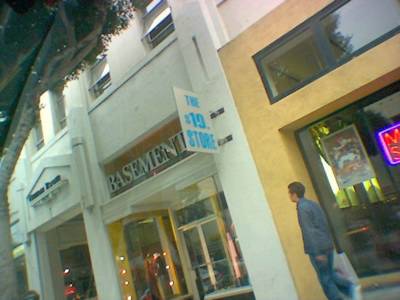
THE $10 STORE. Because 99 cents doesn't pay the rent.
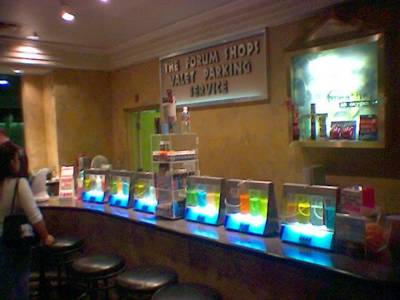
What's valet parking without an oxygen bar for while you wait, right?
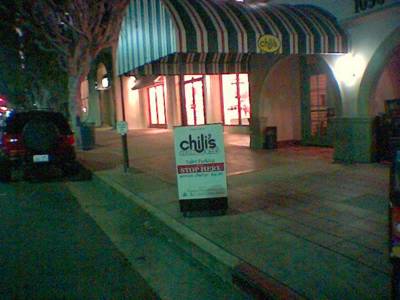
And what's a fancy restaurant like Chilis without valet parking?

Christmas. Beverly Hills style.

Wouldn't your restaurant be cleaner if you had to post your grade in the window? (ok, this one's certainly not new.. but deserves mention nonetheless!)

Err, how'd that make it in?! Ah well, smog sure makes for colorful sunsets.
And I'll leave you with that for now. Stay tuned.. a special issue of Best of Sky Mall is on the way!
Though I grew up in LA, I've spent the last several years learning/researching/working at the University of Michigan in Ann Arbor. I'm lucky enough to have a great group of friends out here, who have continually put up with my efforts to convince them that their beautiful state leaves something to be desired... (and I'm not just talking about the weather.. though it is 25 degrees and blizzarding as I write)
I'm not quite sure why it takes so long for great ideas from Fastpay parking to drive-thru Starbucks to make their way out to Michigan.. But in the spirit of sharing, I've brought back with me from the West Coast a few pictures of the latest and greatest to hit the streets:

Glow-in-the-Dark Mini Golf! (Because blacklight bowling just wasn't enough.)

Palm Tree? Or cell phone tower in disguise?

THE $10 STORE. Because 99 cents doesn't pay the rent.

What's valet parking without an oxygen bar for while you wait, right?

And what's a fancy restaurant like Chilis without valet parking?

Christmas. Beverly Hills style.

Wouldn't your restaurant be cleaner if you had to post your grade in the window? (ok, this one's certainly not new.. but deserves mention nonetheless!)

Err, how'd that make it in?! Ah well, smog sure makes for colorful sunsets.
And I'll leave you with that for now. Stay tuned.. a special issue of Best of Sky Mall is on the way!
Saturday, December 25, 2004
$47.33
Call me old-fashioned, but I've yet to download from an online music store.
Is it because I'm a starving student that feels ripped off by the recording industry? Absolutely not. I'm a firm believer in intellectual property rights, and support the recording industry charging whatever people will pay for their products.
So if I'm willing to pay for my music, and I own an iPod, and I use iTunes to listen to my music, why have I resisted so intently on trying the iTunes music store?
To illustrate this well-documented area where DRM (Digital Rights Management) a la iTunes falls short, I'd like to tell you about some books I just purchased through Amazon.com's used books Marketplace.
The three books I purchased retail at $13.95, $33.95, and $16.00 respectively.
I paid $2.21, $13.61, and $0.75 respectively for used copies in "Like New" condition.
That's right. Seventy-five cents for a like-new, hardcover, 176 page book. How? The apparently well-read book was published 7 years ago, and the marketplace has been flooded with copies that owners are ready to re-sell (103 owners in the Amazon.com marketplace alone, to be precise).
By purchasing these books from previous owners, I saved $47.33 (or 74%).
The same phenomenon can be found with CDs. Ever been to a used music store? Or taken advantage of an offer to trade in 5 used CDs for 1 new one? You get the point..
By paying to download music (or more accurately, by paying to license music), you lose the right to resell music you no longer wish to listen to. Even if this "feature" were provided by services like the iTunes music store, you would probably be limited to reselling your music to other iTunes users. Apple has addressed this issue in the past, claiming it's "impractical".
What "impractical" really means is that it is not in Apple's best interest, and certainly not in the best interest of the RIAA.
In fact, while the RIAA has long played victim in the effects of the Internet on their business, in truth they have much more to gain from it. Imagine if book publishers had the chance to get rid of libraries, used book stores, and used online sales (the same kind that just saved me $47.33, or I should say lost them $47.33). This is effectively what online music stores in their current incarnation have the ability to do for the recording industry.
Again, call me old-fashioned, but when I buy a book, I like to be able to resell it when I'm done reading it, or even give it away to a friend (I often give copies to my favorite books to friends, then go buy another new copy to re-stock my bookshelf). I like to be able to read my book anywhere. I like to be able to walk into a store and pay cash for my book in a semi-anonymous transaction, and not have the contents of my bookshelf known to some corporation.
These are all rights that have been taken away with the advent of online music stores. They are also problems to which there are undoubtedly technical solutions if companies were so-inclined to explore them. Unfortunately, nobody has stepped up to the plate. I imagine companies feel that to do so would not be profitable. I would disagree, and in fact suggest that in part because all DRM to this day has been broken, and in part because the music is available from CD without any DRM anyway, the first company to offer the ability to resell, give away, use unrestricted, and use anonymously would gain a clear competitive edge.
Live to dream...
Is it because I'm a starving student that feels ripped off by the recording industry? Absolutely not. I'm a firm believer in intellectual property rights, and support the recording industry charging whatever people will pay for their products.
So if I'm willing to pay for my music, and I own an iPod, and I use iTunes to listen to my music, why have I resisted so intently on trying the iTunes music store?
To illustrate this well-documented area where DRM (Digital Rights Management) a la iTunes falls short, I'd like to tell you about some books I just purchased through Amazon.com's used books Marketplace.
The three books I purchased retail at $13.95, $33.95, and $16.00 respectively.
I paid $2.21, $13.61, and $0.75 respectively for used copies in "Like New" condition.
That's right. Seventy-five cents for a like-new, hardcover, 176 page book. How? The apparently well-read book was published 7 years ago, and the marketplace has been flooded with copies that owners are ready to re-sell (103 owners in the Amazon.com marketplace alone, to be precise).
By purchasing these books from previous owners, I saved $47.33 (or 74%).
The same phenomenon can be found with CDs. Ever been to a used music store? Or taken advantage of an offer to trade in 5 used CDs for 1 new one? You get the point..
By paying to download music (or more accurately, by paying to license music), you lose the right to resell music you no longer wish to listen to. Even if this "feature" were provided by services like the iTunes music store, you would probably be limited to reselling your music to other iTunes users. Apple has addressed this issue in the past, claiming it's "impractical".
What "impractical" really means is that it is not in Apple's best interest, and certainly not in the best interest of the RIAA.
In fact, while the RIAA has long played victim in the effects of the Internet on their business, in truth they have much more to gain from it. Imagine if book publishers had the chance to get rid of libraries, used book stores, and used online sales (the same kind that just saved me $47.33, or I should say lost them $47.33). This is effectively what online music stores in their current incarnation have the ability to do for the recording industry.
Again, call me old-fashioned, but when I buy a book, I like to be able to resell it when I'm done reading it, or even give it away to a friend (I often give copies to my favorite books to friends, then go buy another new copy to re-stock my bookshelf). I like to be able to read my book anywhere. I like to be able to walk into a store and pay cash for my book in a semi-anonymous transaction, and not have the contents of my bookshelf known to some corporation.
These are all rights that have been taken away with the advent of online music stores. They are also problems to which there are undoubtedly technical solutions if companies were so-inclined to explore them. Unfortunately, nobody has stepped up to the plate. I imagine companies feel that to do so would not be profitable. I would disagree, and in fact suggest that in part because all DRM to this day has been broken, and in part because the music is available from CD without any DRM anyway, the first company to offer the ability to resell, give away, use unrestricted, and use anonymously would gain a clear competitive edge.
Live to dream...
Thursday, December 23, 2004
"Property Irregularity"

So after 12 hours of holiday cross-country travel on delayed flights, I finally arrive in Los Angeles. After a good 30 minutes, the luggage carousel stops moving, and my bags are nowhere in sight.
Great. I have a flashback of packing my bags 15 hours earlier.. "I can just toss my glasses and phone charger in here.. I mean, it's only a short flight.. it's not like I'm going to China.."
I head over to the jampacked lost baggage room, wait half an hour in line, only to be told "Well of course your bags aren't here, sir. They were only checked through to Houston".
I explain to the nice gentleman that I clearly explained to the check-in agent that I was traveling to Los Angeles, and showed him the boarding passes that were issued for both flights.
To which the lost baggage agent replies, "Well sir, it's very important that you tell the agent when you check in that the bags should be sent to your final destination."
At this point, my body thinks it's 4am in this morning, and I don't have the energy to even begin to get upset. So I just nod understandably, and explain to the lost baggage agent, "Gotcha. Next time I check in, I'll be sure to explain specifically that I am traveling to Los Angeles and my bags are traveling to Los Angeles too." This sent a contagious chuckle through the room of other tired, aggravated passengers.
To make matters worse, so many people have apparently lost their luggage that the luggage delivery service is backed up 1-2 days, and the airline won't allow passengers to return to pick up their bags at the airport. The 800 number on my "Property Irregularity Report" (great name!) has been busy all day, and Customer Service has kindly explained that that department's "phones are all messed up". The tracking tool on their web site is broken as well.
My only question is, why didn't the check-in agent's software automatically check my bags through to my final destination? Aren't computers supposed to prevent this type of human error? Double-check my luggage tags? It all just feels so... 1980s.
Cheers, Continental. Happy Holidays to you too.
Sunday, December 19, 2004
Travel sites, here's some free advice!
I've been thinking a lot lately about taking a 2-3 week trip somewhere after school. I don't really care where, so long as it's outside the US and somewhere I haven't already been (Mexico, Canada, Caribbean, Ireland, England, Netherlands, France, and Israel).
I'd especially like to see Asia, especially Tokyo and Hong Kong. Perhaps its a coincidence, and/or perhaps it's related to having just finished reading two books set in Japan (Digital Dreams: The work of the Sony Design Center) and China (The Diamond Age), both of which got me thinking about how close we are in the world of technology and the Internet despite our distances and differences. It amazes me how many people I know here in the US that have never visited the East, myself included.
So I got to thinking.. How does one go about finding plane tickets when he knows when he wants to travel, and has a general idea about but doesn't know exactly where he wants to go and exactly how much he wants to spend?
Yahoo! Travel is one of the last remaining travel sites I know of that allows users to search by destination without specifying dates, then sort through the results based on price.
But wouldn't it be cool if there was a site that allowed users to search by whichever parameters they choose (origin, destination, price, date, duration) and sort based on whichever parameters they choose as well?
It seems the major travel sites - Orbitz, Expedia, the airlines themselves - have only incorporated search as an auxiliary function of their E-Commerce driven sites.
Wouldn't it be cool to be able to search for roundtrip flights from anywhere in Southern California to anywhere in Western Europe, not necessarily to/from the same cities (maybe I could fly into London, out of Paris, chunnel between), results sorted by duration, date, price, and destination?
Wouldn't it be cool to enter an originating city, a date range, a duration range, and be shown a map of Asia with a price on every major city? Then hover my mouse pointer over a city to get more information? Or adjust a simple slider to change the date range or duration?
Google's built a sustainable business out of search and advertising. Why couldn't Orbitz? If you're intelligent, you only use Orbitz for search anyhow, right? You search Orbitz for the cheapest flight, then purchase your ticket from the airline directly and save the $7-$16 booking fee you would've paid to Orbitz.
At this point, I'd argue that Orbitz banks on many people not being intelligent and/or not caring (similar to Casinos that bank on the same). But expanding their search functionality wouldn't deprive them of that income stream. And if they don't do it, someone else will come along and do it in their place (Google?).
It would potentially facilitate more ticket sales.. the airlines could sell more tickets on routes for which demand isn't high to consumers that would otherwise not fly.
Though whether that is in fact the case or not doesn't much matter.. if Orbitz, Expedia, and/or the airlines don't do it, someone else will in their place.. eventually.. I hope..
I'd especially like to see Asia, especially Tokyo and Hong Kong. Perhaps its a coincidence, and/or perhaps it's related to having just finished reading two books set in Japan (Digital Dreams: The work of the Sony Design Center) and China (The Diamond Age), both of which got me thinking about how close we are in the world of technology and the Internet despite our distances and differences. It amazes me how many people I know here in the US that have never visited the East, myself included.
So I got to thinking.. How does one go about finding plane tickets when he knows when he wants to travel, and has a general idea about but doesn't know exactly where he wants to go and exactly how much he wants to spend?
Yahoo! Travel is one of the last remaining travel sites I know of that allows users to search by destination without specifying dates, then sort through the results based on price.
But wouldn't it be cool if there was a site that allowed users to search by whichever parameters they choose (origin, destination, price, date, duration) and sort based on whichever parameters they choose as well?
It seems the major travel sites - Orbitz, Expedia, the airlines themselves - have only incorporated search as an auxiliary function of their E-Commerce driven sites.
Wouldn't it be cool to be able to search for roundtrip flights from anywhere in Southern California to anywhere in Western Europe, not necessarily to/from the same cities (maybe I could fly into London, out of Paris, chunnel between), results sorted by duration, date, price, and destination?
Wouldn't it be cool to enter an originating city, a date range, a duration range, and be shown a map of Asia with a price on every major city? Then hover my mouse pointer over a city to get more information? Or adjust a simple slider to change the date range or duration?
Google's built a sustainable business out of search and advertising. Why couldn't Orbitz? If you're intelligent, you only use Orbitz for search anyhow, right? You search Orbitz for the cheapest flight, then purchase your ticket from the airline directly and save the $7-$16 booking fee you would've paid to Orbitz.
At this point, I'd argue that Orbitz banks on many people not being intelligent and/or not caring (similar to Casinos that bank on the same). But expanding their search functionality wouldn't deprive them of that income stream. And if they don't do it, someone else will come along and do it in their place (Google?).
It would potentially facilitate more ticket sales.. the airlines could sell more tickets on routes for which demand isn't high to consumers that would otherwise not fly.
Though whether that is in fact the case or not doesn't much matter.. if Orbitz, Expedia, and/or the airlines don't do it, someone else will in their place.. eventually.. I hope..
Friday, December 17, 2004
Dynamism.com - Sushi Disk

Hilarious.
Dynamism is an awesome site for foreign tech imports. They're actually carrying a rebranded version of the HTC Blue Angel phone I just bought off Ebay as well.
(As their inventory changes often, I doubt these links will continue to function indefinitely.)
Tuesday, December 14, 2004
Semiautomated Teller Machine Contraptions
About a year ago, my bank opened a new branch in the Union here at the University of Michigan next to an ATM that had existed as long as I can remember. Opting to be as efficient as possible (human interaction can be so pesky, right?), I continued to use the ATM rather than the tellers at the branch.
One day, the ATM was out of order, and I decided to go into the bank. Strangely, this branch had no tellers. Rather, it had about 4 kiosks consisting of video monitors, a telephone, and a strange looking capsule. The instructions on the kiosk indicated that I was to fill out a withdrawal form, place it in the capsule with identification, and wait for a teller to appear on the screen!
I have to admit, I was a bit taken aback by this contraption that looked like something out of the Jetsons. On top of my confusion and the growing line of people behind me, I quickly realized that I didn't have my account number handy to put on the withdrawal form. I was used to using my ATM card + pin at a machine! Not knowing what to do or how to get ahold of someone on the other end, I sort-of backed away sheepishly.
This encounter made me rather depressed. Here I am, a pretty bright Computer Science student at the University of Michigan, unable to work a Jetsonsesque semi-automated teller machine contraption.
A few days ago, the ATM was out of order again. This gave me the perfect 2nd chance. As I walked into the branch, I realized that yet again I had the same account number issue. Luckily, there was a bank rep there to answer any questions. He said if I dropped my ATM card into the capsule, they wouldn't need my account number. Brilliant. It was a rather exciting experience actually.. sending away my signed withdrawal slip & ATM card into oblivion and getting it back minutes later accompanied by $80. I found myself wondering where the nice girl on the screen in front of me actually sat. On another floor where space is less expensive, I suppose. In the future, maybe she'll be all the way in Bangalore, right? :-)
Anyhow, I can't express how much of an idiot I felt like going through this whole ordeal. Finally, the other day, I broke down and admitted my stupidity in shame to a fellow Computer Science student. His response blew me away. He was also afraid of trying the strange semi-automated teller machine contraptions!
At this point, I knew that it had nothing to do with stupidity at all. Rather, it fit right in with other similar, scary feelings I've encountered from time to time over the last 2-3 years: I'm becoming extinct.
I remember playing Super Mario Brothers on my new Nintendo when I was 5 or 6 years old, and the awe that my parents and every other grown-up had of my Nintendo-playing generation. To them, Pong was revolutionary. Toss them a NES controller, and they wouldn't know what to do with it. Toss me an NES controller, and I knew exactly which one of the 999,999 bushes to burn in The Legend of Zelda to open a secret cave and win 500 rupees.
Almost twenty years later, a 10 year old with a PS2 controller could most certainly hand me my ass on a platter at whatever is the latest version of Grand Theft Auto..
Don't get me wrong.. I try to stay current. The problem is, I didn't use to have to try. I had all day and all night to play on my Nintendo, and later my computer, growing up -- especially during those fantastically long elementary school summer vacations!
Now, while I'm still absolutely ahead of the technology curve among my peers, I realize that I'll inevitably fall behind among members of the next several generations. In 30 years, they'll confidently be explaining their new technology to me as I confidently explain it to my Dad and his friends today.
Even as I continue to invent and innovate, today's kids will take my technology and hack it up for uses unimaginable and unforeseeable to me or anyone else -- like my generation and the generation before me have also done.
When my kids are reading e-books, I may still be reading paperbacks -- because I like the feel.. just as my father liked the feel of writing on his paper legal pads until finally taking that leap into the unknown and learning to use a word processor ("back in my day", they didn't have graphical user interfaces and we had to retrofit the function keys on the keyboard with inserts explaining which keys mapped to which functions -- it really was a leap for Dad).
I can just imagine it now.. "When I was young, we had to drive the cars ourselves! They had foot pedals, and a big wheel, and we had to turn on a flashing light every time we wanted to change direction!"
I hope it's awhile before I start having more of these feeling of extinction experiences.. I vow to always tackle them head on.. But I'll always remember the time when I didn't have to tackle them at all.. the time when it all just came naturally.
One day, the ATM was out of order, and I decided to go into the bank. Strangely, this branch had no tellers. Rather, it had about 4 kiosks consisting of video monitors, a telephone, and a strange looking capsule. The instructions on the kiosk indicated that I was to fill out a withdrawal form, place it in the capsule with identification, and wait for a teller to appear on the screen!
I have to admit, I was a bit taken aback by this contraption that looked like something out of the Jetsons. On top of my confusion and the growing line of people behind me, I quickly realized that I didn't have my account number handy to put on the withdrawal form. I was used to using my ATM card + pin at a machine! Not knowing what to do or how to get ahold of someone on the other end, I sort-of backed away sheepishly.
This encounter made me rather depressed. Here I am, a pretty bright Computer Science student at the University of Michigan, unable to work a Jetsonsesque semi-automated teller machine contraption.
A few days ago, the ATM was out of order again. This gave me the perfect 2nd chance. As I walked into the branch, I realized that yet again I had the same account number issue. Luckily, there was a bank rep there to answer any questions. He said if I dropped my ATM card into the capsule, they wouldn't need my account number. Brilliant. It was a rather exciting experience actually.. sending away my signed withdrawal slip & ATM card into oblivion and getting it back minutes later accompanied by $80. I found myself wondering where the nice girl on the screen in front of me actually sat. On another floor where space is less expensive, I suppose. In the future, maybe she'll be all the way in Bangalore, right? :-)
Anyhow, I can't express how much of an idiot I felt like going through this whole ordeal. Finally, the other day, I broke down and admitted my stupidity in shame to a fellow Computer Science student. His response blew me away. He was also afraid of trying the strange semi-automated teller machine contraptions!
At this point, I knew that it had nothing to do with stupidity at all. Rather, it fit right in with other similar, scary feelings I've encountered from time to time over the last 2-3 years: I'm becoming extinct.
I remember playing Super Mario Brothers on my new Nintendo when I was 5 or 6 years old, and the awe that my parents and every other grown-up had of my Nintendo-playing generation. To them, Pong was revolutionary. Toss them a NES controller, and they wouldn't know what to do with it. Toss me an NES controller, and I knew exactly which one of the 999,999 bushes to burn in The Legend of Zelda to open a secret cave and win 500 rupees.
Almost twenty years later, a 10 year old with a PS2 controller could most certainly hand me my ass on a platter at whatever is the latest version of Grand Theft Auto..
Don't get me wrong.. I try to stay current. The problem is, I didn't use to have to try. I had all day and all night to play on my Nintendo, and later my computer, growing up -- especially during those fantastically long elementary school summer vacations!
Now, while I'm still absolutely ahead of the technology curve among my peers, I realize that I'll inevitably fall behind among members of the next several generations. In 30 years, they'll confidently be explaining their new technology to me as I confidently explain it to my Dad and his friends today.
Even as I continue to invent and innovate, today's kids will take my technology and hack it up for uses unimaginable and unforeseeable to me or anyone else -- like my generation and the generation before me have also done.
When my kids are reading e-books, I may still be reading paperbacks -- because I like the feel.. just as my father liked the feel of writing on his paper legal pads until finally taking that leap into the unknown and learning to use a word processor ("back in my day", they didn't have graphical user interfaces and we had to retrofit the function keys on the keyboard with inserts explaining which keys mapped to which functions -- it really was a leap for Dad).
I can just imagine it now.. "When I was young, we had to drive the cars ourselves! They had foot pedals, and a big wheel, and we had to turn on a flashing light every time we wanted to change direction!"
I hope it's awhile before I start having more of these feeling of extinction experiences.. I vow to always tackle them head on.. But I'll always remember the time when I didn't have to tackle them at all.. the time when it all just came naturally.
Thursday, December 02, 2004
<a noref>?
Check out http://www.martinlutherking.org/
Notice anything strange? Well.. maybe not at a very quick first glance. But if you click around for a moment or two, you'll probably realize rather quickly that it's a hate site run by a white supremacist group (the same group that runs www.stormfront.org - look at how many people participate in their online forums. scary.).
The shocking thing is that in a Google search for "Martin Luther King", the above site comes up 4th (as of today, December 2nd, 2004).
I did a bit of investigating into this a couple months back. It turns out that the reason this site is listed 4th is because of the large number of sites on the Internet that link to it as an example of racism and/or misinformation.
Interesting, isn't it? Web sites of elementary school libraries link to www.martinlutherking.org as an example of a site students should *not* use, and in doing so, contribute to its rankings in the major search engines (search engines compute rank in large part based on how many other web sites link to a given site).
This is not a new piece of news. The site has been around for quite some time, and many a blogger/journalist/librarian has written about the situation. However, for my own education, I began a one person email campaign to the maintainers of the sites linking to www.martinlutherking.org. I explained how their linking to it actually helps it in terms of search engine rank, and in-turn only helps the spread of misinformation -- exactly what many of these people were attempting to combat.
There were 3 classes of people who replied:
A. People who were not aware of the problem, thanked me for the notification, and removed the link (but perhaps kept the text without an actual link).
B. People who actually didn't realize the site was a racist/white surpremacist site and immediately removed the link and thanked me.
C. People who understood the issue (either before or after receiving my email), but decided to keep the link intact for one of the following reasons:
So, I started thinking about ways to solve this problem. The fundamental idea behind using number of links to determine page rank is the notion of link structure as a recommender system. That is, by linking to a site, you are in fact recommending it to your users.
But is this always the case? Certainly not. Even Google utilizes server-side scripts to exclude some sites to which they link (such as Blogger blogs) from inhereting PageRank from www.google.com.
So, I came up with this mindblowingly simple solution. Why not provide a simple way for one site to link to another without "recommending" it?
A simple way to do this would be to allow for an optional "noref" parameter in the html anchor tag (<a>). So, a url that would not be seen as a recommendation would look something like:
<a href="http://www.google.com" noref>Google</a>
An optional additional parameter would be backwards compatible most if not all of the time. So why not implement it?
Thoughts? Suggestions? Just a thought off the top of my head.. but something that could certainly be built upon..
Notice anything strange? Well.. maybe not at a very quick first glance. But if you click around for a moment or two, you'll probably realize rather quickly that it's a hate site run by a white supremacist group (the same group that runs www.stormfront.org - look at how many people participate in their online forums. scary.).
The shocking thing is that in a Google search for "Martin Luther King", the above site comes up 4th (as of today, December 2nd, 2004).
I did a bit of investigating into this a couple months back. It turns out that the reason this site is listed 4th is because of the large number of sites on the Internet that link to it as an example of racism and/or misinformation.
Interesting, isn't it? Web sites of elementary school libraries link to www.martinlutherking.org as an example of a site students should *not* use, and in doing so, contribute to its rankings in the major search engines (search engines compute rank in large part based on how many other web sites link to a given site).
This is not a new piece of news. The site has been around for quite some time, and many a blogger/journalist/librarian has written about the situation. However, for my own education, I began a one person email campaign to the maintainers of the sites linking to www.martinlutherking.org. I explained how their linking to it actually helps it in terms of search engine rank, and in-turn only helps the spread of misinformation -- exactly what many of these people were attempting to combat.
There were 3 classes of people who replied:
A. People who were not aware of the problem, thanked me for the notification, and removed the link (but perhaps kept the text without an actual link).
B. People who actually didn't realize the site was a racist/white surpremacist site and immediately removed the link and thanked me.
C. People who understood the issue (either before or after receiving my email), but decided to keep the link intact for one of the following reasons:
- Search engine rank is something for the search engines to deal with. If the search engines are ranking something higher than they should be, it's their own problem.
- Removing the link makes it difficult for some users to access the information. They won't understand why clicking on the text does not work.
So, I started thinking about ways to solve this problem. The fundamental idea behind using number of links to determine page rank is the notion of link structure as a recommender system. That is, by linking to a site, you are in fact recommending it to your users.
But is this always the case? Certainly not. Even Google utilizes server-side scripts to exclude some sites to which they link (such as Blogger blogs) from inhereting PageRank from www.google.com.
So, I came up with this mindblowingly simple solution. Why not provide a simple way for one site to link to another without "recommending" it?
A simple way to do this would be to allow for an optional "noref" parameter in the html anchor tag (<a>). So, a url that would not be seen as a recommendation would look something like:
<a href="http://www.google.com" noref>Google</a>
An optional additional parameter would be backwards compatible most if not all of the time. So why not implement it?
Thoughts? Suggestions? Just a thought off the top of my head.. but something that could certainly be built upon..
Wednesday, December 01, 2004
The Road to Redmond
[Names have been changed to protect the innocent]
I wasn’t quite sure what would happen next when I walked out of my campus interview with Microsoft. I guess that’s something the candidate’s supposed to ask, or the interviewer’s supposed to bring up. I had more important questions to ask at the time, and it slipped my mind. I figured I’d hear back eventually if they were interested. So many applicants.. what were the chances they’d pick me anyhow?
Lots of time passed.. the process was progressing with other companies.. I had had a great final round interview with Deloitte.. and still no word from Microsoft. At this point, I asked Ayush, my MS intern friend, for some advice. He happened to have the regional recruiter’s cell phone number, and suggested I call her up to again express my interest and let her know about the offer I was expecting from Deloitte. I think I caught Nancy a bit off guard, but she was very friendly and helpful. She was in a cab on her way to an airport, but had all the paperwork from my university’s interviews in her backpack, and said she’d get back to me asap to let me know the results.
A few days later I got an email from Nancy telling me they’d like to fly me out to Redmond for a day of interviews! She said a Microsoft recruiting coordinator would be in touch.
I was pretty ecstatic, but remained calm. I knew how many college candidates Microsoft flies out to interview every day, and that the odds of getting an offer were stacked against me something like 6-1. I have one really bright friend at the University who’s interviewed with Microsoft in Redmond for the last 2 years, each time going home without an offer, and another friend who’s an amazing programmer and also made it all the way to Redmond and back without getting an offer.
I exchanged a few more emails with Nancy and her coworker Barbara about the process, and about a week later, I got an email from Hillary, my recruiting coordinator, with a bunch of questions and information to help plan and prepare for my trip to Redmond. The potential dates she provided were a bit outside my decision-making timeframe, so I played a bit of phone tag with Hillary and her coworker Laura until finally agreeing on a Monday that’d I’d be flying out 4 days later!
Touching Down
I got into Seattle around 6:30pm and took a cab out to the Fairfield Inn in Bellevue – just minutes away from Microsoft’s main campus. The hotel was pretty dead, and I desperately needed to eat, so I took a walk down the street to Red Robin where I sat alone at the bar eating a burger & fries and sipping on a Guinness. It was a bit lonely, but gave me some much needed time to reflect on the situation and get psyched up for the morning. Went back to the hotel an hour later, checked my email (free wireless!), and crashed.
I woke up pretty early the next morning. I pretty much remained jetlagged for my entire trip, actually. I knew I was going to be spending the entire day running from building to building interviewing in all kinds of strange places, and decided to take Microsoft up on its advice, and wear something I’d be comfortable in. Threw on a pair of Dockers, a sky blue Banana Republic polo-like shirt, my brown cloth/suede shoes, and went off to breakfast at the Courtyard next door.
Wow, was breakfast a wakeup call! There were college aged candidates swarming around the hotel every which way I turned my head – taxi after taxi driving up and taking them off to the famed Building 19 where all the magic begins. I grabbed some eggs and toast at the buffet, and sat down to eat. Next to me were two Microsoft guys chatting about how their group was severely understaffed, but they preferred to keep it that way because interviewing candidates was such a long, drawn-out process that it just wasn’t worth the effort. Great, I thought. After I was done eating, I walked across the room to a comfortable-looking chair, and whipped out my copy of How Would You Move Mount Fuji? I had already taken the book cover off so as not to look like a complete and total dork. Ah, last minute cramming.
My cab arrived around 10. I split it with another candidate who was applying for a developer position. We chatted a bit about the companies we’d been interviewing with. Good times.
Building 19
Building 19 was just as it looked in the Channel9 videos and just as it was described in my book (except the Xbox was working! Yay!). I checked in, chatted a bit with other candidates, then sat down and whipped out my Gameboy Advance to kill some time. Everyone else was wearing a suit. Great.
Around 10:30, a very nice woman named Jackie approached from behind the nearby smartcard-protected door and introduced herself as the recruiter who would be handling my campus visit. She was totally cool. We went back to her office, and chatted a bit about my interests, her time at the company, and our shared passion for the Pocket PC. Jackie gave me a primer interview question to prepare me for my day, and a few helpful tips. She also gave me some vouchers for a free meal with one of my interviewers later in the day. It was a really fun conversation. I think I’ll call her up and see if she wants to get lunch when I get back to Redmond again. Eventually, it was time to move on, and I hopped on the recruiting shuttle to my first technical interview. Even the recruiting shuttle, by the way, was a fun time. The drivers were all very friendly and easy to chat with, and I got to ride in my first Hybrid vehicle. Waay cool!
Jim
My first interview of the day was with Jim, in the Windows CE group. The lobby of Jim’s building had a couple of enlarged Smartphone devices by the entrance. Spiffy, eh? As we went up to Jim’s office, he asked if I needed a drink or anything. I thanked him for the offer, but was ready to jump right into the interview.
Jim was a lead PM in the CE group. We hit it off right away, talking about all sorts of stuff related to mobile devices. The interview was mostly behavioral. He wanted to get a sense of my skills as a PM. He asked lots of questions about my past experiences working with groups on projects. Then, the conversation shifted somehow to a mobile technology proof of concept video I’d seen on a Microsoft Research web site. Here’s the link. We talked a lot about how this technology could be applied to navigation applications, and produced a lot of great ideas. It was a great time.
When our time was up, Jim walked me back down to the lobby and called me a shuttle to another building where I’d be meeting another PM lead in his group, Jack.
At this point, Jim also mentioned something about calling Jack and giving him a heads up I was on my way.
Jack
When I got to Jack’s building, I had to wait around for a few minutes.. apparently there had been some sort of scheduling issue with my interviews (Jackie mentioned it as well early on in the day), and people weren’t expecting me at the times Jackie/I were given. I didn’t mind the wait.. it gave me time to gather my thoughts, take in my surroundings, and rest my brain before the next round of challenging questions.
When Jack arrived, he asked if I’d had lunch yet. I hadn’t, but told him I was in no hurry, and that it was only my second interview. I could last a bit longer. So, we went up to his office.
Jack was probably the most technical guy I met with. His office was dark, and every square inch was covered with gadgets. I actually figured him for a developer or a tester initially. Turns out he is a PM, but has access to the codebase as well and likes to tinker. Pretty neat.
All of Jack’s questions were about handling issues that arise during the development cycle – new feature requests, missed deadlines, etc. Everything I’d read in The Mythical Man-Month came in handy here (i.e. don’t just throw more developers at a problem, or shorten the testing time). Jack had some insights I hadn’t thought about much before our interview, and that was helpful as well.
All in all, it was another good interview. Jack called me a shuttle, and I was on my way to another building!
Johnnie B
The next building I got to had an MSNBC kiosk in the lobby. Good thing, too, because it was a good 10-15 minutes before I met my next interviewer, Jose. I took the opportunity to relax again, and prepare myself for whatever the next guy had in store for me.
After a few minutes, a man approached, and introduced himself as Johnnie B (another lead PM). He said that because of the issues with my schedule, I’d be meeting with him rather than Jose, who had gone off to an important meeting.
Johnnie B was very nice. We talked about the project his team was working on quite a bit. He said he worked in a group called Windows Technology Services. He gave me a lot of time to ask questions about PM at Microsoft and the company in general. Then, he posed me an interview question.
Answering Johnnie B’s question was definitely the biggest challenge I faced throughout the day. I’d read up quite a bit on Microsoft’s interview questions and the various coding, design, and puzzle questions the interviewers ask. Nothing prepared me for this question.
I sat in front of him exploring option after option, searching the solution space as best as possible, and yet I couldn’t come up with a viable solution. As more and more time passed, and there was still no solution in sight, I started to worry. Here I was, in the hot seat, with my worst fear coming true: a puzzle question I wasn’t able to answer. He (or I) shot down every potential solution I came up with. In the back of my mind I thought that this was the end for sure, or I hoped that the others wouldn’t take his opinion as much into consideration.
So finally, the clock runs out on me, and I ask him, “How would you solve this problem?” To which Johnnie B answers, “there’s no solution to the problem”. So I sat silent for a moment with a grin on my face, then asked him, “Would you expect, or have you ever had a candidate sit in front of you and tell you that there was no solution to your problem?” He answered that it was more the process he was looking at, and suddenly, it all made sense.
Out of respect for Johnnie B and the process, I’m not gonna post the question on my blog. Even had I expected an unsolvable problem, I probably wouldn’t have answered much differently. What if I was wrong, and there was a solution I simply hadn’t found yet? Give up?
Anyhow, I guess I did alright, because I continued to have more interviews (at Microsoft, the number of interviews you have depends on your performance throughout the day).
Morgan
After Johnnie B was done grilling me, he walked me down the hall to his coworker Morgan’s office. I was asked to wait outside for a few minutes while they talked about me. It’s alright, I expected as much.
Morgan was another lead PM, same group. We chatted some more about program management, about my experiences, challenges, successes, interests. Morgan also had a consulting background, which I could relate to. The interview still involved being creative and problem solving skills, but it definitely felt good to be back out of the hotchair again.
After meeting with Morgan, I was again offered some refreshments. My throat was getting dry, and I’d realized that it was already late afternoon and I’d missed out on lunch. So I had this bright idea of snagging a Mountain Dew out of the fridge (btw Microsoft has a GREAT selection of free beverages).
Mountain Dew in hand, I was walked over to Jose’s office. It turns out that Jose’s the general manager of the Windows Technology Services group. Again, I hung out in the hall while Jose, Johnnie B, and Morgan talked about me. There was a proof on one of the whiteboards showing how 2=3. Hmm...
Jose
Jose had a nice corner office – indicative of his position I suppose. Looking out through the windows, I noticed it was starting to get dark outside. The Mountain Dew was starting to kick in, giving me a much needed second wind.
Jose was a lively, energetic kind of guy. His interview style was very aggressive. It was also getting late, and I could tell he wanted to get home to his family (Friday night.. Shabbat – something we connected on, actually). We spent a lot more time getting to know each other than solving problems. He began the interview by looking at the clock, and saying something along the lines of “I’m gonna tell you about myself in 2 minutes, then you do the same”. He had me rank the divisions of the company in which I was most interested, and asked a few practical questions like “In order for you to accept a job right now, who would you have to talk to?” (I told him: my hiring manager and one of my future coworkers). I think my answer may have led to my next interview with Johnnie R, another PM, actually.
I’m not gonna detail the rest of the interview with Jose. He’s an important guy, and I have a feeling some of the information discussed wasn’t meant to be broadcasted to the world. We chatted for what I recall to be something like 30-40 minutes. Like every other interview, it was pretty intense, but a good time nonetheless.
Johnnie R
Johnnie R was the last person I met at the company. He’s a PM in the same group, and gave me a good feel for what it would be like to work on the team. We interviewed each other for a good 45 minutes, mostly about our interests and experience, and then walked back to Building 19 together where we met back up with Jackie, with whom I started the day. She had her daughter with her too – cute as a button! We chatted for a few minutes, I told her about my amazing and intense day (she seemed very disappointed that I hadn’t had the chance to eat, despite it really being my own fault), and then she gave me some company swag and sent me off in a cab with a few other candidates back to the hotel.
Final Thoughts
I recently accepted an offer from Microsoft for a PM position with the Windows Technology Services group. Everyone I met on the team was bright, energetic, intelligent, and motivated, which certainly ended up being one of the deciding factors. I suppose I was lucky to be matched up with such a great group of people – I’ve heard stories from friends about being matched up with groups that just didn’t do it for them. I guess if there was one thing that could be improved about the process it would be the matching process between candidate and division. I lucked out with Technology Services, but generally it would seem to make sense to match candidates with divisions working with technologies about which they may already be passionate. I would’ve also liked to have spent more time getting to know members of the Windows CE group. The process seemed to grind to a halt with that group as soon as I started interviewing with Technology Services, despite all of the interviews apparently having gone very well. Again though, I lucked out in the end.
One thing I’ve noticed about the company was that almost everyone I’ve spoken with (as part of or outside of the interview process) has been there for 5, 10, 15+ years. Going into the process, I viewed Microsoft as a great place to launch my career. If I was happy staying there indefinitely, great. But more likely than not, I’d move on to other great opportunities after having it on my resume for 2-3 years. After meeting the people, experiencing the environment, and receiving the details of my offer, that mindset completely changed. They very obviously take great care of their employees. Without going into detail, the offer was substantially higher than the others I received as part of the University recruiting process. The benefits were amazing as well. It’s obvious that they value their employees and go above and beyond to keep them happy working at the company.
Finally, I can’t stress how important it was to do some recon before beginning the recruiting process with Microsoft. If you don’t have what they’re looking for, no amount of reading or preparation is going to get you a job. But if you do have what they’re looking for, it might just help it come through in your interviews.
Err.. one more crucial thing. The day definitely plays out based on how the first couple of interviews go. William Poundstone explains this in How Would You Move Mount Fuji?, and I certainly experienced it firsthand. The interviewers email, phone, and face-to-face chat between interviews. I had a great first interview, and the day kept getting better and better from there. Have a not-so-great first interview, and you may find yourself in a difficult position. What interviewer wants to recommend hiring a candidate that his colleague just publicly recommended against hiring? Again, covered in more detail by the book (wow, by this point one might think I'm taking kickbacks or something..).
So again, some great resources:
How Would You Move Mount Fuji?
Technical Careers @ Microsoft
What is it like to interview with Microsoft?
Riding the Recruiting Shuttle
Mock White Boarding Problem
If you would like to read more about my experiences with University recruiting and with other companies, I've written a bit about them in another post.
I wasn’t quite sure what would happen next when I walked out of my campus interview with Microsoft. I guess that’s something the candidate’s supposed to ask, or the interviewer’s supposed to bring up. I had more important questions to ask at the time, and it slipped my mind. I figured I’d hear back eventually if they were interested. So many applicants.. what were the chances they’d pick me anyhow?
Lots of time passed.. the process was progressing with other companies.. I had had a great final round interview with Deloitte.. and still no word from Microsoft. At this point, I asked Ayush, my MS intern friend, for some advice. He happened to have the regional recruiter’s cell phone number, and suggested I call her up to again express my interest and let her know about the offer I was expecting from Deloitte. I think I caught Nancy a bit off guard, but she was very friendly and helpful. She was in a cab on her way to an airport, but had all the paperwork from my university’s interviews in her backpack, and said she’d get back to me asap to let me know the results.
A few days later I got an email from Nancy telling me they’d like to fly me out to Redmond for a day of interviews! She said a Microsoft recruiting coordinator would be in touch.
I was pretty ecstatic, but remained calm. I knew how many college candidates Microsoft flies out to interview every day, and that the odds of getting an offer were stacked against me something like 6-1. I have one really bright friend at the University who’s interviewed with Microsoft in Redmond for the last 2 years, each time going home without an offer, and another friend who’s an amazing programmer and also made it all the way to Redmond and back without getting an offer.
I exchanged a few more emails with Nancy and her coworker Barbara about the process, and about a week later, I got an email from Hillary, my recruiting coordinator, with a bunch of questions and information to help plan and prepare for my trip to Redmond. The potential dates she provided were a bit outside my decision-making timeframe, so I played a bit of phone tag with Hillary and her coworker Laura until finally agreeing on a Monday that’d I’d be flying out 4 days later!
Touching Down
I got into Seattle around 6:30pm and took a cab out to the Fairfield Inn in Bellevue – just minutes away from Microsoft’s main campus. The hotel was pretty dead, and I desperately needed to eat, so I took a walk down the street to Red Robin where I sat alone at the bar eating a burger & fries and sipping on a Guinness. It was a bit lonely, but gave me some much needed time to reflect on the situation and get psyched up for the morning. Went back to the hotel an hour later, checked my email (free wireless!), and crashed.
I woke up pretty early the next morning. I pretty much remained jetlagged for my entire trip, actually. I knew I was going to be spending the entire day running from building to building interviewing in all kinds of strange places, and decided to take Microsoft up on its advice, and wear something I’d be comfortable in. Threw on a pair of Dockers, a sky blue Banana Republic polo-like shirt, my brown cloth/suede shoes, and went off to breakfast at the Courtyard next door.
Wow, was breakfast a wakeup call! There were college aged candidates swarming around the hotel every which way I turned my head – taxi after taxi driving up and taking them off to the famed Building 19 where all the magic begins. I grabbed some eggs and toast at the buffet, and sat down to eat. Next to me were two Microsoft guys chatting about how their group was severely understaffed, but they preferred to keep it that way because interviewing candidates was such a long, drawn-out process that it just wasn’t worth the effort. Great, I thought. After I was done eating, I walked across the room to a comfortable-looking chair, and whipped out my copy of How Would You Move Mount Fuji? I had already taken the book cover off so as not to look like a complete and total dork. Ah, last minute cramming.
My cab arrived around 10. I split it with another candidate who was applying for a developer position. We chatted a bit about the companies we’d been interviewing with. Good times.
Building 19
Building 19 was just as it looked in the Channel9 videos and just as it was described in my book (except the Xbox was working! Yay!). I checked in, chatted a bit with other candidates, then sat down and whipped out my Gameboy Advance to kill some time. Everyone else was wearing a suit. Great.
Around 10:30, a very nice woman named Jackie approached from behind the nearby smartcard-protected door and introduced herself as the recruiter who would be handling my campus visit. She was totally cool. We went back to her office, and chatted a bit about my interests, her time at the company, and our shared passion for the Pocket PC. Jackie gave me a primer interview question to prepare me for my day, and a few helpful tips. She also gave me some vouchers for a free meal with one of my interviewers later in the day. It was a really fun conversation. I think I’ll call her up and see if she wants to get lunch when I get back to Redmond again. Eventually, it was time to move on, and I hopped on the recruiting shuttle to my first technical interview. Even the recruiting shuttle, by the way, was a fun time. The drivers were all very friendly and easy to chat with, and I got to ride in my first Hybrid vehicle. Waay cool!
Jim
My first interview of the day was with Jim, in the Windows CE group. The lobby of Jim’s building had a couple of enlarged Smartphone devices by the entrance. Spiffy, eh? As we went up to Jim’s office, he asked if I needed a drink or anything. I thanked him for the offer, but was ready to jump right into the interview.
Jim was a lead PM in the CE group. We hit it off right away, talking about all sorts of stuff related to mobile devices. The interview was mostly behavioral. He wanted to get a sense of my skills as a PM. He asked lots of questions about my past experiences working with groups on projects. Then, the conversation shifted somehow to a mobile technology proof of concept video I’d seen on a Microsoft Research web site. Here’s the link. We talked a lot about how this technology could be applied to navigation applications, and produced a lot of great ideas. It was a great time.
When our time was up, Jim walked me back down to the lobby and called me a shuttle to another building where I’d be meeting another PM lead in his group, Jack.
At this point, Jim also mentioned something about calling Jack and giving him a heads up I was on my way.
Jack
When I got to Jack’s building, I had to wait around for a few minutes.. apparently there had been some sort of scheduling issue with my interviews (Jackie mentioned it as well early on in the day), and people weren’t expecting me at the times Jackie/I were given. I didn’t mind the wait.. it gave me time to gather my thoughts, take in my surroundings, and rest my brain before the next round of challenging questions.
When Jack arrived, he asked if I’d had lunch yet. I hadn’t, but told him I was in no hurry, and that it was only my second interview. I could last a bit longer. So, we went up to his office.
Jack was probably the most technical guy I met with. His office was dark, and every square inch was covered with gadgets. I actually figured him for a developer or a tester initially. Turns out he is a PM, but has access to the codebase as well and likes to tinker. Pretty neat.
All of Jack’s questions were about handling issues that arise during the development cycle – new feature requests, missed deadlines, etc. Everything I’d read in The Mythical Man-Month came in handy here (i.e. don’t just throw more developers at a problem, or shorten the testing time). Jack had some insights I hadn’t thought about much before our interview, and that was helpful as well.
All in all, it was another good interview. Jack called me a shuttle, and I was on my way to another building!
Johnnie B
The next building I got to had an MSNBC kiosk in the lobby. Good thing, too, because it was a good 10-15 minutes before I met my next interviewer, Jose. I took the opportunity to relax again, and prepare myself for whatever the next guy had in store for me.
After a few minutes, a man approached, and introduced himself as Johnnie B (another lead PM). He said that because of the issues with my schedule, I’d be meeting with him rather than Jose, who had gone off to an important meeting.
Johnnie B was very nice. We talked about the project his team was working on quite a bit. He said he worked in a group called Windows Technology Services. He gave me a lot of time to ask questions about PM at Microsoft and the company in general. Then, he posed me an interview question.
Answering Johnnie B’s question was definitely the biggest challenge I faced throughout the day. I’d read up quite a bit on Microsoft’s interview questions and the various coding, design, and puzzle questions the interviewers ask. Nothing prepared me for this question.
I sat in front of him exploring option after option, searching the solution space as best as possible, and yet I couldn’t come up with a viable solution. As more and more time passed, and there was still no solution in sight, I started to worry. Here I was, in the hot seat, with my worst fear coming true: a puzzle question I wasn’t able to answer. He (or I) shot down every potential solution I came up with. In the back of my mind I thought that this was the end for sure, or I hoped that the others wouldn’t take his opinion as much into consideration.
So finally, the clock runs out on me, and I ask him, “How would you solve this problem?” To which Johnnie B answers, “there’s no solution to the problem”. So I sat silent for a moment with a grin on my face, then asked him, “Would you expect, or have you ever had a candidate sit in front of you and tell you that there was no solution to your problem?” He answered that it was more the process he was looking at, and suddenly, it all made sense.
Out of respect for Johnnie B and the process, I’m not gonna post the question on my blog. Even had I expected an unsolvable problem, I probably wouldn’t have answered much differently. What if I was wrong, and there was a solution I simply hadn’t found yet? Give up?
Anyhow, I guess I did alright, because I continued to have more interviews (at Microsoft, the number of interviews you have depends on your performance throughout the day).
Morgan
After Johnnie B was done grilling me, he walked me down the hall to his coworker Morgan’s office. I was asked to wait outside for a few minutes while they talked about me. It’s alright, I expected as much.
Morgan was another lead PM, same group. We chatted some more about program management, about my experiences, challenges, successes, interests. Morgan also had a consulting background, which I could relate to. The interview still involved being creative and problem solving skills, but it definitely felt good to be back out of the hotchair again.
After meeting with Morgan, I was again offered some refreshments. My throat was getting dry, and I’d realized that it was already late afternoon and I’d missed out on lunch. So I had this bright idea of snagging a Mountain Dew out of the fridge (btw Microsoft has a GREAT selection of free beverages).
Mountain Dew in hand, I was walked over to Jose’s office. It turns out that Jose’s the general manager of the Windows Technology Services group. Again, I hung out in the hall while Jose, Johnnie B, and Morgan talked about me. There was a proof on one of the whiteboards showing how 2=3. Hmm...
Jose
Jose had a nice corner office – indicative of his position I suppose. Looking out through the windows, I noticed it was starting to get dark outside. The Mountain Dew was starting to kick in, giving me a much needed second wind.
Jose was a lively, energetic kind of guy. His interview style was very aggressive. It was also getting late, and I could tell he wanted to get home to his family (Friday night.. Shabbat – something we connected on, actually). We spent a lot more time getting to know each other than solving problems. He began the interview by looking at the clock, and saying something along the lines of “I’m gonna tell you about myself in 2 minutes, then you do the same”. He had me rank the divisions of the company in which I was most interested, and asked a few practical questions like “In order for you to accept a job right now, who would you have to talk to?” (I told him: my hiring manager and one of my future coworkers). I think my answer may have led to my next interview with Johnnie R, another PM, actually.
I’m not gonna detail the rest of the interview with Jose. He’s an important guy, and I have a feeling some of the information discussed wasn’t meant to be broadcasted to the world. We chatted for what I recall to be something like 30-40 minutes. Like every other interview, it was pretty intense, but a good time nonetheless.
Johnnie R
Johnnie R was the last person I met at the company. He’s a PM in the same group, and gave me a good feel for what it would be like to work on the team. We interviewed each other for a good 45 minutes, mostly about our interests and experience, and then walked back to Building 19 together where we met back up with Jackie, with whom I started the day. She had her daughter with her too – cute as a button! We chatted for a few minutes, I told her about my amazing and intense day (she seemed very disappointed that I hadn’t had the chance to eat, despite it really being my own fault), and then she gave me some company swag and sent me off in a cab with a few other candidates back to the hotel.
Final Thoughts
I recently accepted an offer from Microsoft for a PM position with the Windows Technology Services group. Everyone I met on the team was bright, energetic, intelligent, and motivated, which certainly ended up being one of the deciding factors. I suppose I was lucky to be matched up with such a great group of people – I’ve heard stories from friends about being matched up with groups that just didn’t do it for them. I guess if there was one thing that could be improved about the process it would be the matching process between candidate and division. I lucked out with Technology Services, but generally it would seem to make sense to match candidates with divisions working with technologies about which they may already be passionate. I would’ve also liked to have spent more time getting to know members of the Windows CE group. The process seemed to grind to a halt with that group as soon as I started interviewing with Technology Services, despite all of the interviews apparently having gone very well. Again though, I lucked out in the end.
One thing I’ve noticed about the company was that almost everyone I’ve spoken with (as part of or outside of the interview process) has been there for 5, 10, 15+ years. Going into the process, I viewed Microsoft as a great place to launch my career. If I was happy staying there indefinitely, great. But more likely than not, I’d move on to other great opportunities after having it on my resume for 2-3 years. After meeting the people, experiencing the environment, and receiving the details of my offer, that mindset completely changed. They very obviously take great care of their employees. Without going into detail, the offer was substantially higher than the others I received as part of the University recruiting process. The benefits were amazing as well. It’s obvious that they value their employees and go above and beyond to keep them happy working at the company.
Finally, I can’t stress how important it was to do some recon before beginning the recruiting process with Microsoft. If you don’t have what they’re looking for, no amount of reading or preparation is going to get you a job. But if you do have what they’re looking for, it might just help it come through in your interviews.
Err.. one more crucial thing. The day definitely plays out based on how the first couple of interviews go. William Poundstone explains this in How Would You Move Mount Fuji?, and I certainly experienced it firsthand. The interviewers email, phone, and face-to-face chat between interviews. I had a great first interview, and the day kept getting better and better from there. Have a not-so-great first interview, and you may find yourself in a difficult position. What interviewer wants to recommend hiring a candidate that his colleague just publicly recommended against hiring? Again, covered in more detail by the book (wow, by this point one might think I'm taking kickbacks or something..).
So again, some great resources:
How Would You Move Mount Fuji?
Technical Careers @ Microsoft
What is it like to interview with Microsoft?
Riding the Recruiting Shuttle
Mock White Boarding Problem
If you would like to read more about my experiences with University recruiting and with other companies, I've written a bit about them in another post.
Subscribe to:
Posts (Atom)
